Solten & Co. Research Report
August 21, 2026
Software AI · Creative AI · Capital & Deals
Research Snapshot
Research type: Flagship Research Report
Evidence cut-off: August 21, 2026
Estimated reading time: ~35 minutes
Executive Summary
Higgsfield’s $400 million Series B at a $5.4 billion valuation is easy to dismiss as another aggressive AI funding round. That would miss the more important signal. The company is becoming a useful test case for where economic value may settle in generative media as video and image models proliferate.
Higgsfield does not primarily compete by training the largest proprietary foundation model. Its platform aggregates more than 50 image, video and audio models — including Seedance, Kling, GPT Image and others — while adding proprietary workflow, identity, agentic and production tools such as Soul, Cinema Studio, Marketing Studio, Supercomputer and Canvas. The company is betting that the scarce asset in creative AI will not always be the model itself. It may be the layer that selects models, preserves brand and character consistency, coordinates multi-step production, governs enterprise use and owns the customer workflow.
The financing reflects extraordinary reported growth. Higgsfield says annualized revenue reached $700 million in August 2026, up from a $200 million annualized run-rate metric reported in January. The company says it has more than 30 million users and supports visual production at 390 of the Fortune 500. The Series B values the company at roughly 7.7 times the company-stated annualized revenue metric. But the revenue figure requires discipline: in January, Reuters corrected its report after the company clarified that the run-rate figure was a projection and not recognized revenue. The August number should therefore be treated as a company-stated annualized metric, not as audited trailing revenue.
The industry context makes the case more consequential. IAB research shows that 83% of advertising executives now say their companies use AI in the creative process. Nearly two-thirds of digital-video buyers already use generative AI in video creative, and buyers expect the share of video assets touched by GenAI to rise further by 2027. At the same time, only 45% of surveyed Gen Z and Millennial consumers say they feel positive about AI-generated ads, and Gen Z is notably more skeptical than Millennials. Production adoption is outrunning cultural acceptance.
This creates a structural shift in the creative economy. When the marginal cost of producing another visual, ad variant, storyboard or short video collapses, production stops being the only scarce resource. Scarcity migrates toward taste, brand governance, distribution, performance measurement, legal rights, attention and the ability to coordinate many models without creating inconsistent output. The economic center of gravity can therefore move from isolated generation tools toward operating systems for creative production.
Higgsfield’s strategy is important because competitors are converging toward the same architecture. Runway, once most clearly differentiated as a proprietary video-model lab, now offers third-party models and an API that aggregates image, video, audio and character models. Adobe Firefly now exposes partner models from companies including Google, OpenAI and Runway inside governed enterprise workflows. Canva explicitly describes a multi-model approach while integrating Google Veo. The market is moving toward hybrid systems: proprietary intelligence where differentiation matters, third-party model choice where it does not, and workflow ownership above both.
The central Solten & Co. thesis is that creative-model commoditization does not destroy value; it relocates it. The winners may be companies that control the workflow between intent and finished commercial content. That layer can capture value through model routing, collaboration, identity consistency, brand memory, enterprise security, legal indemnification, asset management, publishing and measurement. If this thesis is correct, Higgsfield is not merely an AI-video company. It is attempting to become a creative operating system.
The counter-thesis is equally important. Aggregation businesses can be squeezed from both sides. Foundation-model providers can improve their own workflows and enterprise products. Incumbents such as Adobe and Canva already own enormous installed user bases, file formats, collaboration patterns and distribution surfaces. If model access is broadly available everywhere, Higgsfield’s differentiation may prove shallow. Its reported revenue could also carry significant inference costs, promotional usage, churn or enterprise experimentation that make headline run-rate growth less durable than it appears.
The investment question is therefore not whether AI-generated video will grow. That is increasingly obvious. The deeper question is: who owns the control point when creative production becomes a model-orchestrated system?
Key Findings
- The Higgsfield round is structurally meaningful, not merely large. The $5.4 billion valuation is a market bet on an application and workflow layer above multiple foundation models.
- Reported commercial velocity is exceptional but must be normalized. The company-stated annualized metric rose from $200 million in January to $700 million in August, while valuation rose from $1.3 billion to $5.4 billion.
- Model aggregation is becoming a mainstream architecture. Higgsfield, Runway, Adobe and Canva all now combine proprietary capabilities with third-party model access.
- The moat is migrating from raw generation toward workflow control. Brand consistency, model routing, collaboration, enterprise governance, distribution and measurement become more valuable as model quality converges.
- Advertising is the first major economic laboratory. AI creative adoption is already mainstream among buyers, and the cost benefit is shifting from experimentation toward operating-model redesign.
- Creative agencies face unbundling, not simple extinction. Production volume can move in-house while strategy, taste, brand stewardship, high-end craft and integrated campaign design retain value.
- Enterprise adoption depends on legal and governance infrastructure. Higgsfield’s enterprise tier adds no-training terms, SOC 2, SSO, dedicated capacity and indemnification because large companies need more than generation quality.
- Consumer trust can become a bottleneck. AI-ad adoption is rising faster than consumer enthusiasm, making disclosure, authenticity and quality part of the economics rather than mere ethics.
- Inference economics remain the largest financial unknown. A platform that routes to third-party models can scale revenue rapidly while carrying variable model costs that may pressure gross margin.
- The next competition is for the creative operating system. The winning platform may own the brief, brand memory, workflow, model selection, asset graph and performance feedback loop — while treating models as interchangeable infrastructure.
Table of Contents
- What Changed
- Higgsfield: From Creator Tool to Enterprise Creative Platform
- The Financing: What the $5.4 Billion Valuation Actually Says
- Revenue Quality: The Most Important Unanswered Question
- Why the Aggregator Strategy Matters
- The Market Is Converging on Hybrid Architectures
- Advertising Is the First Economic Shockwave
- The Agency Model: Unbundling Production From Judgment
- In-House Creative Becomes More Powerful
- The Economics of Infinite Variants
- The New Scarcity: Taste, Attention and Governance
- Enterprise Trust Becomes Product
- Copyright, Likeness and Disclosure
- Creators: Empowerment and Labor Substitution at the Same Time
- Media and Entertainment: From Production Tool to Distribution System
- Who Captures Value?
- Competitive Implications
- Solten & Co. Thesis, Counter-Thesis and Falsification
- What to Watch
Sources & Evidence
Methodological Note
About Solten & Co.
Scope & Methodology
This report uses Higgsfield as a case study for a broader question: how value capture changes when generative-media models become increasingly accessible through multiple software layers. It examines financing, product architecture, enterprise adoption, advertising economics, agency structure, creator labor, intellectual-property risk and competition among creative platforms.
Primary evidence includes Higgsfield product, enterprise, terms and financing disclosures; IAB industry research; Kuaishou investor disclosures; Runway product and financing materials; Adobe product and legal documentation; Canva product announcements; and WPP filings and strategy materials. Reuters and the Financial Times are used for high-quality reported context where private-company economics are not independently disclosed.
The report distinguishes company-stated metrics from independently verified financial results. Higgsfield’s annualized revenue metric is not treated as audited revenue. Customer counts and Fortune 500 usage are company claims unless independently corroborated.
1. What Changed
Six months ago, Higgsfield was already unusual. In January 2026 it raised an $80 million Series A extension that valued the company at more than $1.3 billion. Reuters reported a $200 million annualized run-rate metric and noted that the company explicitly said the figure was a projection, not recognized revenue. At the time, Higgsfield positioned itself as an application-layer company integrating third-party models rather than trying to outspend OpenAI or Google on foundation-model training.
By August, the scale and positioning had changed. Higgsfield announced a $400 million Series B at a $5.4 billion valuation led by DST Global, with Growth Equity at Goldman Sachs Alternatives, Tribe Capital, Intel Capital and others participating. The company said annualized revenue had reached $700 million and global users exceeded 30 million.
More important than the headline valuation is the reported change in customer mix. Financial Times reporting says business customers now account for the majority of revenue, reversing the earlier consumer-heavy profile. Higgsfield itself says its enterprise base spans advertising, media, broadcasting, fashion, retail, financial services and pharmaceuticals, and that 390 Fortune 500 companies use the platform for visual production.
The product also expanded from generation toward orchestration. Higgsfield’s enterprise offering combines more than 50 models with Cinema Studio, Soul ID, Marketing Studio, Canvas, MCP and CLI integrations, governance controls, dedicated capacity and an agentic product called Supercomputer. The company says usage of its agentic products grew 42-fold in three months after the May rollout.
This is the real inflection point: Higgsfield is trying to own the workflow around creative intelligence rather than any single model.
2. Higgsfield: From Creator Tool to Enterprise Creative Platform
Higgsfield was founded by Alex Mashrabov, previously a generative-AI executive at Snap and co-founder of AI Factory, which Snap acquired in 2020. The company launched its browser-based creative platform publicly in 2025 and initially gained traction among creators and social-media marketers.
The creator entry point matters because it gave Higgsfield a high-frequency environment for learning workflows. Creative users do not simply ask for one finished video. They generate many shots, test styles, edit outputs, preserve character identity, combine models and move assets across tools. That produces a different product requirement from a single text-to-video endpoint.
The current enterprise product is built around this broader workflow. Higgsfield offers model choice across image, video and audio; shared credit pools; character and brand consistency; camera and cinematography controls; collaborative Canvas; agentic production; enterprise SSO; dedicated capacity; usage controls; and integration with tools such as ChatGPT, Claude and Figma through MCP and CLI.
The architecture resembles an operating layer. The model is one component, not the product boundary.
3. The Financing: What the $5.4 Billion Valuation Actually Says
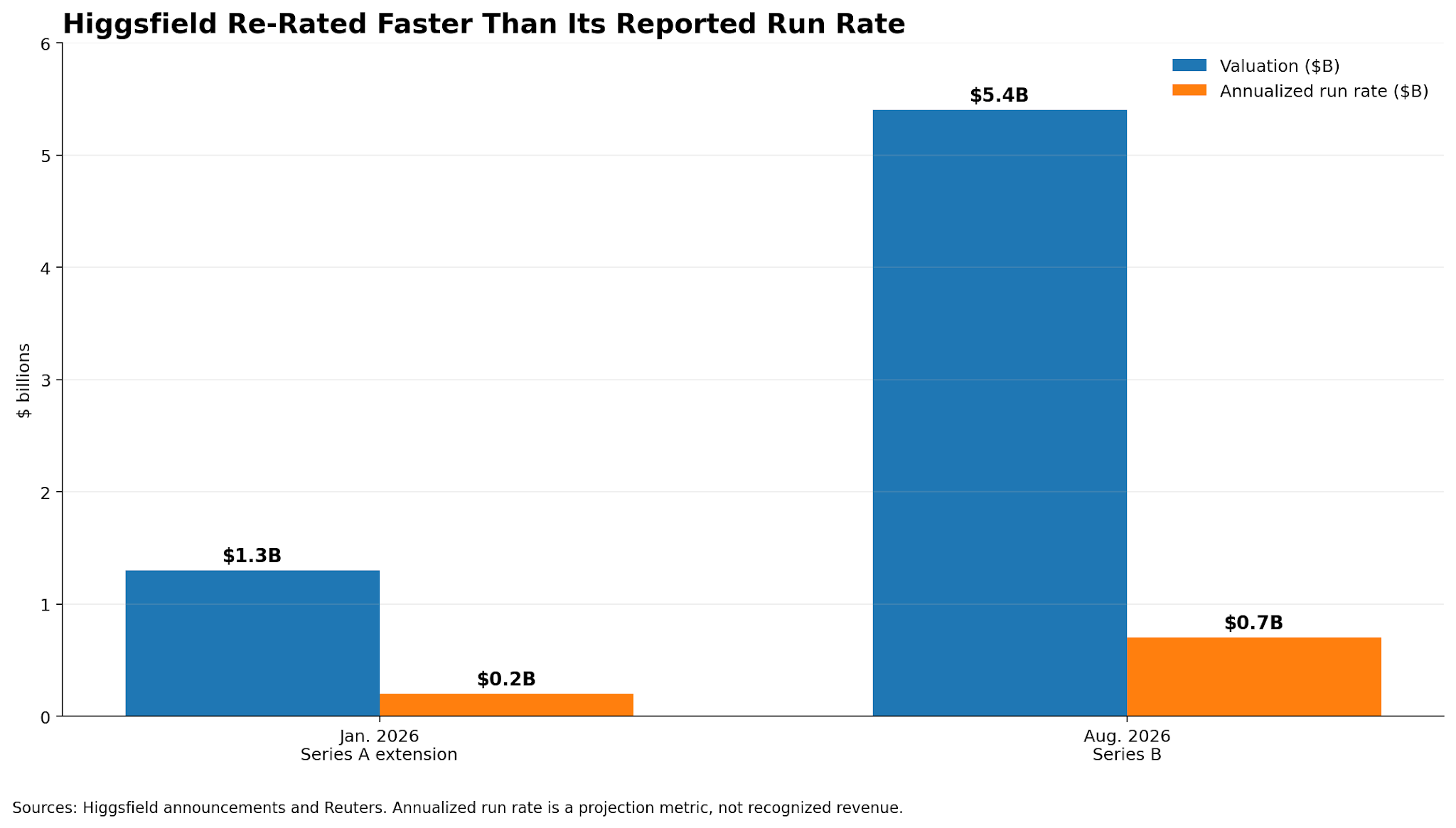
Higgsfield’s valuation rose from more than $1.3 billion in January to $5.4 billion in August. Over the same period, the company-stated annualized metric rose from $200 million to $700 million.
Using those figures mechanically, the implied valuation-to-annualized-run-rate multiple moved from roughly 6.5x to roughly 7.7x. That is notable because the valuation expanded faster than the reported run rate. Investors are therefore underwriting more than current monetization. They are paying for the possibility that Higgsfield becomes a durable control point in a much larger creative-production market.
The investor mix reinforces that interpretation. The Series B includes traditional growth investors, strategic technology capital and investors connected to connectivity, media and distribution. Higgsfield says it will use the capital for global sales, management operations, infrastructure, research and hiring — consistent with a move from viral creator growth toward enterprise platform building.
The valuation is still aggressive. Private-market multiples based on annualized metrics can hide churn, promotions, seasonal behavior and variable delivery costs. The appropriate question is not whether 7.7x is “cheap” or “expensive,” but what quality of recurring gross profit sits underneath the numerator.
4. Revenue Quality: The Most Important Unanswered Question
Higgsfield’s reported top-line velocity is extraordinary. Its January financing release said annual run rate reached $200 million less than nine months after launch; the August release says annualized revenue reached $700 million.
But annualization is especially hazardous in generative AI. Usage can spike around model launches, promotions or unlimited plans. Credits can expire. Some users may buy one-off packs rather than recurring subscriptions. Enterprise customers may begin as pilots. And underlying inference is a real variable cost rather than the near-zero marginal delivery cost associated with classic SaaS.
Higgsfield’s pricing architecture confirms that usage economics matter. Individual and business plans rely on recurring subscriptions, pooled credits, credit packs and model-specific “Unlimited” access. Different models, resolutions and durations consume different amounts of credits. Enterprise adds dedicated capacity and custom credit volumes.
This means revenue quality cannot be assessed without at least five missing metrics:
- recognized trailing revenue versus annualized run rate;
- gross margin after third-party model inference and GPU capacity;
- net revenue retention and churn by creator, team and enterprise cohorts;
- enterprise contract duration and committed spend;
- mix of subscription revenue, credit packs, promotional usage and custom enterprise contracts.
The strongest version of the Higgsfield thesis requires enterprise revenue to grow faster than inference cost and customer acquisition expense. Without that, exceptional top-line growth can still produce fragile economics.
5. Why the Aggregator Strategy Matters
In January, Reuters described Higgsfield’s strategic distinction clearly: rather than competing directly with OpenAI and Google on foundation models, it integrates third-party models and applies proprietary post-training and workflow intelligence.
That choice has three advantages.
First, model competition becomes a supply-side benefit. When Seedance, Kling, Veo, Sora and other models improve or cut prices, Higgsfield can potentially expose better capability without funding every frontier training run itself.
Second, users can choose tools by task. One model may be strongest at motion, another at image consistency, another at audio or editing. A workflow layer can route work rather than force every use case through one model.
Third, Higgsfield can spend more capital on customer workflow, distribution and enterprise controls. The company can compete in the layer where creative teams experience friction: briefing, storyboarding, character continuity, collaboration, permissions, production and export.
The weakness is dependence. If foundation-model providers restrict access, raise prices or build superior workflow products, an aggregator can be squeezed. The durability of the model therefore depends on whether the workflow layer accumulates proprietary customer context and switching costs.
6. The Market Is Converging on Hybrid Architectures
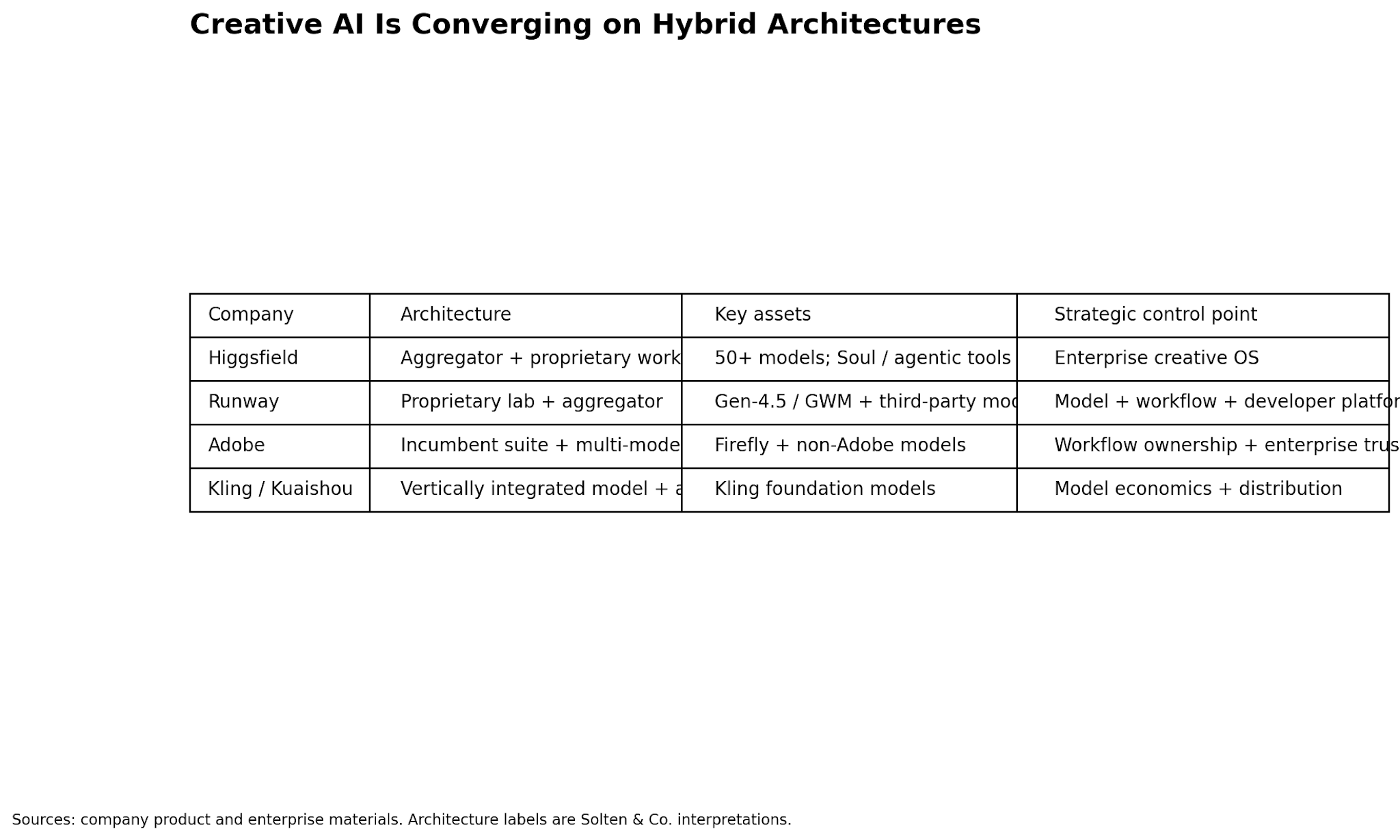
The original distinction between “model lab” and “application company” is already breaking down.
Runway still invests heavily in proprietary models such as Gen-4.5 and its General World Model work. But it now also offers third-party models and launched Runway Dev as one API for leading image, video, audio and character models. Its core product page now explicitly markets access to multiple external models alongside its own.
Adobe is moving the same direction from the opposite starting point. It owns the dominant professional creative workflow, but Firefly now gives users access to partner models including Kling, Runway, Sora and Veo. Adobe’s enterprise product emphasizes governed model choice inside one workflow, exactly the layer Higgsfield is attempting to build.
Canva likewise describes a multi-model approach and integrates Google Veo into its video workflow while also developing its own design foundation model and agentic editing environment.
Kling represents the vertically integrated alternative. Kuaishou owns both a major consumer video platform and the Kling model family. In January 2026 Kuaishou said Kling had reached a $240 million annualized revenue run rate in December 2025.
The convergence suggests that “best model versus best aggregator” is the wrong long-term framing. The likely equilibrium is hybrid: own proprietary intelligence where it creates differentiation, aggregate third-party intelligence where customer choice matters, and capture the workflow around both.
7. Advertising Is the First Economic Shockwave
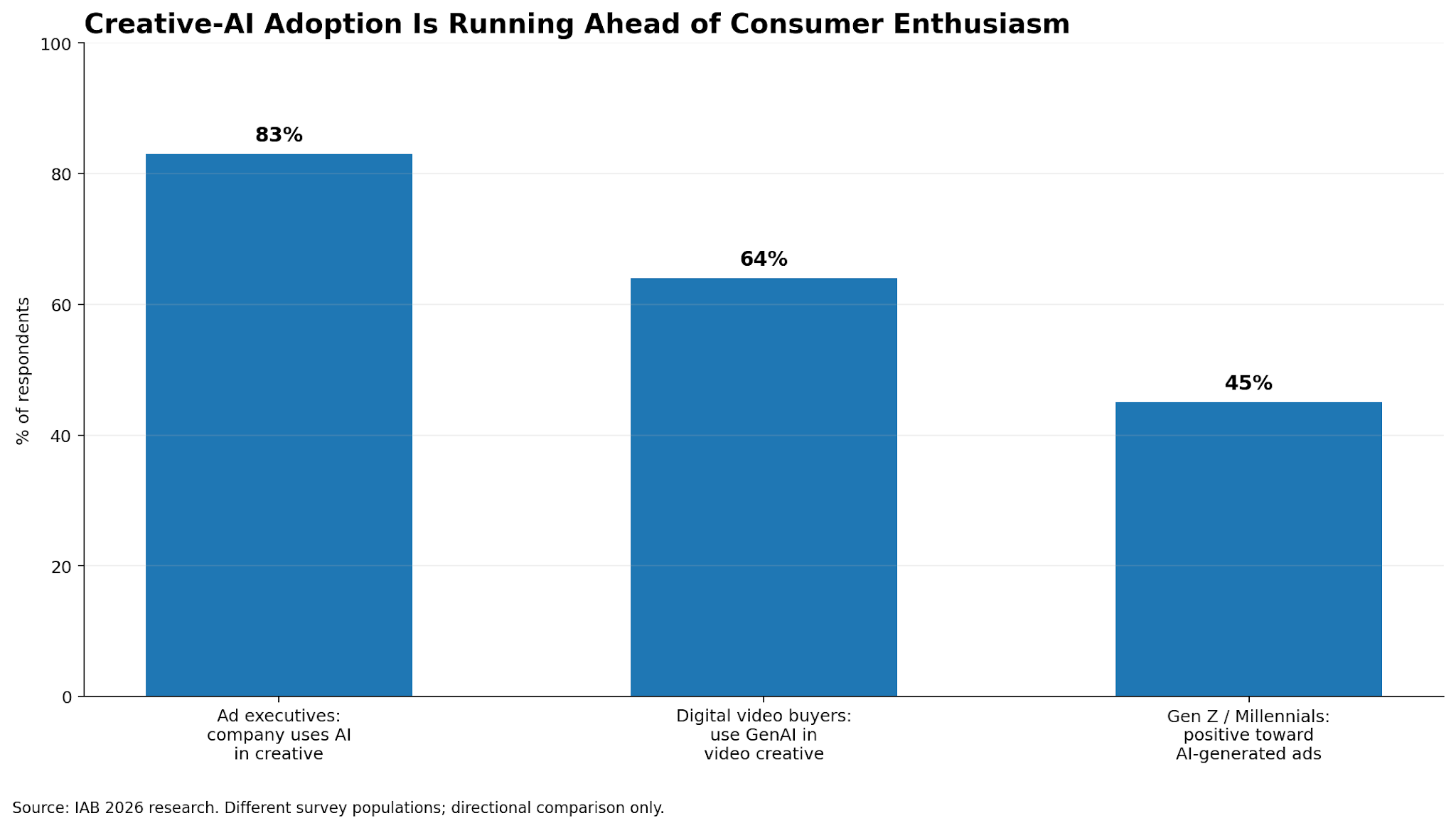
Advertising is the most immediate market because it has high content volume, measurable outcomes and continuous demand for variants.
IAB’s January 2026 research found that 83% of ad executives said their companies had deployed AI in the creative process, up from 60% in the 2024 comparison study. In its 2026 digital-video research, IAB found nearly two-thirds of buyers already use GenAI for digital-video creative and that roughly one-third of ad assets will leverage GenAI in 2026, with the share projected to reach 43% in 2027.
Cost efficiency has moved from experimental benefit to operating priority. IAB found 64% of respondents cited cost efficiency as a benefit of AI in advertising, while the broader 2026 outlook shows AI dominating buyer priorities.
The key economic change is not simply cheaper production. It is a higher feasible number of creative experiments per campaign. A brand can generate more concepts, localize more markets, adapt more aspect ratios, create more product variants and test more messages without proportionally increasing production headcount.
This shifts the optimization problem from “how do we afford enough assets?” toward “which assets should exist, which should be tested and how quickly can performance feedback change the next generation?”
8. The Agency Model: Unbundling Production From Judgment
AI does not eliminate agencies in one step. It unbundles parts of their economics.
Reuters reported in May that global companies are using AI in Indian hubs to bring more advertising work in-house. Kimberly-Clark reduced one content-creation process from 24 days to two hours; other companies are using AI to reduce the cost and logistics of product imagery and global shoots. Analysts cited by Reuters argued that strategic and creative capability becomes more important as scale-based production advantages weaken.
WPP’s own strategy points in the same direction. Its 2025 annual report says WPP Open automates ordinary tasks and delivers faster creative work at scale. The group launched WPP Open Pro as a self-service product designed to help brands plan, create and publish campaigns independently. In 2026, WPP also announced a major simplification of the organization and targeted £500 million of gross annualized cost savings.
The agency threat is therefore not “brands will stop needing creativity.” It is that a larger share of routine production, versioning and activation can move into software and internal teams.
Agency value consequently migrates toward:
- high-level brand and communication strategy;
- taste and creative direction;
- integrated campaign architecture;
- proprietary audience and performance data;
- high-end craft where synthetic output is insufficient;
- governance, rights management and risk control;
- complex coordination across media, channels and geographies.
The middle of the market — production work that is expensive mainly because it is labor-intensive — faces the greatest compression.
9. In-House Creative Becomes More Powerful
Creative AI changes the minimum viable internal team.
A small brand group can now perform tasks previously distributed across copywriters, storyboard artists, motion designers, VFX teams, localization vendors and production coordinators. The output may not match a top global campaign, but it can be sufficient for the large volume of performance marketing, ecommerce, social content and internal experimentation that brands require every week.
Higgsfield’s enterprise product is explicitly designed for this environment: shared workspaces, pooled usage, user controls, enterprise characters, Marketing Studio, training and dedicated AI education.
This has a second-order labor effect. Senior creative judgment may become more valuable because one experienced operator can direct a much larger volume of output. At the same time, entry-level production tasks that historically trained junior talent may shrink. The industry must therefore solve a pipeline problem: if AI automates the apprenticeship work, where do future senior creatives acquire craft and judgment?
10. The Economics of Infinite Variants
Generative AI pushes advertising toward a different production function.
In the old model, each additional polished video or image variant carried meaningful production cost. This naturally limited experimentation. In the new model, generation cost is low enough that the binding constraint becomes the ability to select, evaluate and distribute variants.
This creates three economic effects.
First, creative supply becomes elastic. Smaller advertisers can enter video channels that were previously too expensive, a dynamic IAB explicitly identifies.
Second, content becomes more granular. Brands can tailor creative by audience, geography, product, retailer, language and context.
Third, performance data can become part of generation. Once workflows connect generation to campaign results, creative production becomes iterative rather than episodic.
That favors platforms capable of connecting the brief, generation, brand constraints and performance feedback loop. A pure model endpoint captures only one step.
11. The New Scarcity: Taste, Attention and Governance
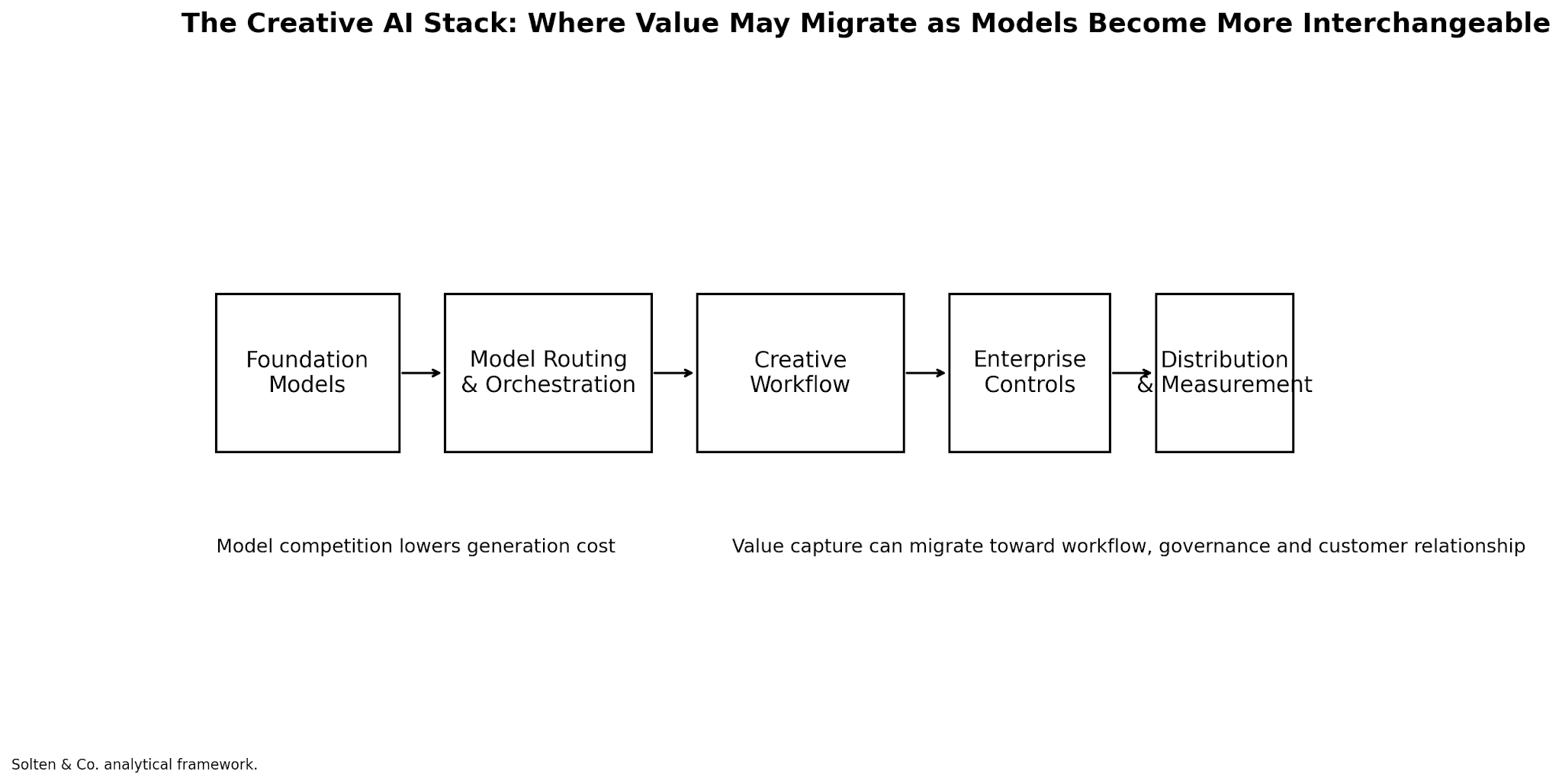
When anyone can create more content, content itself becomes less scarce. The economic bottleneck moves elsewhere.
Taste. The ability to decide what should be made becomes more important when the cost of making the wrong thing falls.
Attention. More supply increases competition for finite human attention. Cheap production does not create cheap distribution.
Brand coherence. High-volume generation can easily fragment tone, visual identity and claims. Systems that preserve brand memory and style become more valuable.
Rights and provenance. Enterprise users need to know whether inputs can be used, whether outputs can be published and who bears legal risk.
Measurement. If thousands of variants can be created, the system that knows which variants actually create business value can capture disproportionate value.
This is the reason workflow ownership may prove more durable than generation quality alone.
12. Enterprise Trust Becomes Product
Higgsfield’s enterprise tier reveals what large customers are actually buying. It is not just better models.
The offering adds SSO, SOC 2 controls, dedicated capacity, advanced administration, no-training terms for enterprise data, commercial rights and legal indemnification. The distinction between normal plans and Enterprise is economically important because it shows that trust, governance and contractual risk allocation are monetizable product features.
Adobe has an especially strong position here. Its Firefly enterprise terms provide indemnification in defined circumstances, and Adobe now extends governed access to selected partner models. That allows an enterprise to use model choice without negotiating separate policies and workflows across every provider.
For Higgsfield, enterprise trust is therefore both opportunity and threat. The company can build a high-value governance layer, but it competes against incumbents whose legal, procurement and security relationships are already embedded inside large organizations.
13. Copyright, Likeness and Disclosure
Generative media remains constrained by rights risk.
Higgsfield’s terms say the company does not claim ownership of users’ inputs or outputs and does not restrict commercial use. But ordinary users remain responsible for ensuring they have rights to uploaded and generated material. Enterprise agreements add no-training commitments and indemnification.
The distinction matters because commercial usability is not the same as non-infringement. A platform can permit commercial use while a generated output still creates copyright, trademark, privacy or likeness risk.
The broader market continues to adapt. On August 17, ByteDance signed an agreement with the Motion Picture Association to strengthen copyright protections around Seedance and Seedream after prior criticism of model outputs. The episode shows that rights management is becoming a product requirement for model distribution in professional creative markets.
Advertising disclosure is also becoming standardized. IAB launched an AI Transparency and Disclosure Framework in January 2026. Its research shows a large gap between advertiser optimism and consumer sentiment, especially among Gen Z.
In other words, legal safety and authenticity can become part of conversion economics. A technically impressive ad that damages brand trust is not an efficient asset.
14. Creators: Empowerment and Labor Substitution at the Same Time
Higgsfield’s creator strategy contains a productive contradiction.
The platform gives independent creators access to capabilities that previously required production crews, visual-effects specialists and large budgets. Higgsfield’s contests and Original Series initiatives create funding and distribution paths for AI-native filmmakers. The company reported thousands of submissions across international creator competitions.
At the same time, the same tools substitute for parts of the labor performed by traditional creators and production specialists. This produces tension around sponsorship, authenticity, training data and professional displacement.
The likely outcome is segmentation rather than one-directional destruction. More people can produce acceptable visual content, while elite human differentiation may move toward concept, storytelling, taste, live performance, distinctive authorship and trusted identity.
The creator economy therefore gets larger at the base while becoming more competitive at the top.
15. Media and Entertainment: From Production Tool to Distribution System
Higgsfield is also experimenting beyond software. In March it launched Higgsfield Original Series, a streaming destination for episodes produced with generative AI. The platform combines creation tools, contests, financing and distribution.
This matters because the long-term control point in media may not stop at production workflow. If a creative platform can identify successful creators, finance content, host distribution and observe audience response, it can build a closed feedback loop between generation and consumption.
The adjacent market is already changing. Reuters reported this week that U.S. microdramas have become a roughly $1.5 billion market and are projected to reach $2 billion next year, with AI helping enable faster and cheaper production in some formats.
Generative media is therefore colliding with an independent trend toward shorter, cheaper and more mobile-native entertainment. The combination can lower the minimum economic scale for a “studio.”
16. Who Captures Value?
The creative AI stack can be divided into five control points:
- Foundation models — raw generation capability and inference economics.
- Routing and orchestration — selecting and combining models.
- Workflow — turning generation into repeatable creative production.
- Enterprise governance — brand, identity, rights, security, collaboration and procurement.
- Distribution and measurement — publishing, audience access and feedback on economic performance.
Foundation-model providers can capture value when capability is scarce and differentiated. But as multiple models become good enough for commercial tasks, price competition increases and value can migrate upward.
Application platforms capture value if they own persistent customer state: brand memory, characters, assets, workflows, approvals, integrations and performance history. That state makes the platform harder to replace even if the underlying model changes.
Incumbent creative suites capture value through installed workflow and file-format ownership. Agencies capture value through strategic judgment, client relationships and cross-channel execution. Brands capture value if AI allows them to internalize more production and retain proprietary performance data.
The future is unlikely to produce one winner. But it can materially redistribute margin across the stack.
17. Competitive Implications
Higgsfield
Its opportunity is to become the neutral creative operating system across models. Its vulnerability is that neutrality can be copied, while incumbents have distribution and model labs can integrate workflow.
Runway
Runway has moved toward the same hybrid architecture while maintaining deep proprietary model research. That may give it a stronger technical hedge: it can capture value both when models differentiate and when aggregation matters. Its expansion into world models also creates optionality outside media.
Adobe
Adobe may have the strongest incumbent position because it already owns professional creative workflows and enterprise trust. Its challenge is avoiding disruption by simpler AI-native interfaces that start with intent rather than traditional editing metaphors.
Canva
Canva is positioned strongly in the mass-market and business-design layer. Its multi-model approach and AI 2.0 strategy show that it sees workflow orchestration, not just generation, as the strategic control point. The main challenge is managing inference cost at hundreds of millions of users.
Kling / Kuaishou
Kling combines a foundation model with large-scale consumer distribution and already reported a $240 million annualized revenue run rate in December 2025. Its model economics and distribution can pressure aggregators, but professional enterprise governance and Western rights concerns can limit adoption in some markets.
Google and OpenAI
Both can push directly into creative workflows, but they may also benefit by supplying models through every major creative platform. Their strategic choice is whether to maximize model distribution or own more of the application-layer economics.
Agencies
The agency response is increasingly to build proprietary orchestration and agentic platforms of their own. WPP Open is one example. Agencies are therefore becoming software companies at the same time software companies are becoming creative-production systems.
18. Solten & Co. Thesis, Counter-Thesis and Falsification
Solten & Co. Thesis
Generative-media models will remain important but become increasingly interchangeable for a large share of commercial creative work. As this occurs, economic value will migrate toward the layer that owns creative workflow, persistent brand context, enterprise governance and distribution feedback. Higgsfield’s $5.4 billion valuation is an early market bet on that migration.
The durable moat is not “access to many models.” Model access can be replicated. The durable moat, if Higgsfield builds one, will be workflow state: the accumulated characters, brand rules, assets, user behavior, integrations, approvals, production graphs and performance data that make model choice invisible to the customer.
Counter-Thesis
The application layer may be structurally weak. Foundation-model providers can commoditize aggregators by offering better native workflows and lower pricing. Adobe and Canva can bundle comparable functionality into products customers already pay for. Model inference may remain too expensive for high gross margins, while professional users may multi-home across platforms. Higgsfield’s reported annualized revenue may therefore represent rapid but low-quality adoption rather than durable platform economics.
Falsification Criteria
- Higgsfield’s recognized revenue materially lags its annualized run-rate claims for several quarters.
- Enterprise customers fail to convert from pilots into multi-year committed contracts.
- Gross margin remains structurally low because third-party video inference captures most of the economics.
- Adobe, Canva or Runway match Higgsfield’s workflow features and materially slow enterprise growth.
- Foundation-model providers restrict third-party access or vertically integrate successful workflows.
- Users consistently select platforms based on the newest model rather than persistent workflow state.
- Consumer backlash or rights restrictions materially reduce the use of AI-generated commercial video.
- Creative performance fails to improve despite higher asset volume, turning “infinite variants” into low-value content inflation.
19. What to Watch
Recognized revenue. The most important financial disclosure would be actual trailing revenue rather than annualized run rate.
Gross margin. Track whether third-party model competition and owned infrastructure drive delivery cost down faster than usage expands.
Enterprise mix. Watch business revenue share, contract duration, committed spend and net retention.
Model concentration. If a small number of third-party models drive most Higgsfield usage, supplier bargaining power is higher than the “50+ models” headline suggests.
Workflow retention. Evidence that users store brand identities, recurring characters, assets and production graphs would support the workflow-state moat.
Adobe and Canva bundling. The rate at which incumbents expose the same partner models inside existing enterprise agreements is a direct competitive test.
Runway’s hybrid strategy. Runway is the clearest comparison because it combines proprietary frontier research with increasingly model-agnostic distribution.
Agency operating models. More self-service launches and cost restructuring at holding companies would support the production-unbundling thesis.
Consumer sentiment. Watch whether disclosure and quality improve acceptance or whether AI-generated advertising produces persistent brand penalties.
Rights architecture. Indemnification, provenance, likeness controls and licensing deals can become enterprise differentiation rather than legal fine print.
Creative performance measurement. The ultimate winner may be the platform that proves AI-generated volume produces incremental business outcomes, not merely more assets.
Sources & Evidence
Higgsfield — primary and company sources
Higgsfield — $400M Series B at $5.4B valuation, August 17, 2026
Higgsfield — Enterprise product
https://higgsfield.ai/enterprise
Higgsfield — Terms of Use, updated July 26, 2026
https://higgsfield.ai/terms-of-use-agreement
Higgsfield — Team and business plan documentation
https://higgsfield.ai/creator-hub/help-center/business/team-and-business-higgsfield
Higgsfield — Credits and usage documentation
https://higgsfield.ai/creator-hub/help-center/credits-and-usage/how-credits-work
Higgsfield — Original Series, March 20, 2026
https://higgsfield.ai/blog/blog-original-series
Independent reporting
Reuters — Higgsfield valuation reaches $5.4B, August 17, 2026
Reuters — Higgsfield reaches $1.3B valuation, January 15, 2026
Financial Times — Higgsfield enterprise shift and financing, August 17, 2026
https://www.ft.com/content/719c8108-f4ae-466b-80f4-96f26558d642
Reuters — Companies use AI to bring more advertising work in-house, May 27, 2026
Reuters — ByteDance / MPA copyright agreement, August 17, 2026
Reuters — U.S. microdrama market, August 18, 2026
Advertising and market structure
IAB — The AI Ad Gap Widens, January 15, 2026
https://www.iab.com/insights/the-ai-gap-widens/
IAB — 2026 Digital Video Ad Spend Report
IAB — 2026 Outlook Study
https://www.iab.com/insights/2026-outlook
IAB — AI Transparency and Disclosure Framework, January 2026
WPP — Annual Report 2025
https://www.wpp.com/en/investors/annual-report-2025
Competitive architecture
Runway — $315M Series E, February 10, 2026
https://runway.com/news/runway-series-e-funding
Runway — Enterprise platform
Runway — Introducing Runway Dev, July 23, 2026
https://runway.com/news/company-news/introducing-runway-dev
Adobe — Partner models in Firefly Creative Production for Enterprise
Canva — Google Veo 3 comes to Canva
https://www.canva.com/newsroom/news/veo3-canva-ai-video/
Canva — Canva AI 2.0
https://www.canva.com/newsroom/news/canva-create-2026-ai/
Kuaishou — Kling AI annualized revenue run rate reaches $240M, January 13, 2026
https://ir.kuaishou.com/node/11176/pdf
Methodological Note
Higgsfield is privately held and does not publish audited quarterly financial statements. Company-stated annualized revenue and run-rate figures are therefore treated as operating indicators rather than recognized trailing revenue. The report does not infer gross margin, retention or enterprise contract quality where those metrics are not disclosed.
Customer counts, Fortune 500 adoption, agentic-product growth and usage statistics are identified as company claims. Industry adoption statistics from IAB come from different respondent samples and are not combined as if they were one matched survey.
The terms creative operating system, workflow state and creative stack are Solten & Co. analytical concepts used to describe potential value capture above foundation models. They are not company-defined categories.
About Solten & Co.
Solten & Co. is an independent research and analysis firm focused on the AI economy. We publish deep research and provide independent investment, company and market analysis for investors and decision-makers evaluating the technologies, businesses, markets and capital structures shaping the next phase of AI.
Need an independent perspective?
Solten & Co. provides independent research and analytical support for investors and decision-makers evaluating companies, markets and investment opportunities across the AI economy.