Solten & Co. Deal Analysis
Published / updated: August 20, 2026
Research universe: AI Infrastructure / Semiconductors / Capital & Deals
Research Passport
Company: Etched
Headquarters: San Jose, California
Founded: 2022
Founders: Gavin Uberti, Robert Wachen, Chris Zhu
Transaction: $700 million financing
Announced valuation: $21 billion
Date announced: August 18, 2026
Lead investor: Jane Street
Other disclosed participants: Kleiner Perkins, Sequoia, Andreessen Horowitz, Tiger Global, Bain Capital Ventures, Neo, Primary, Stripes, Positive Sum, and Blackstone
Company-stated total funding: $1.9 billion
Evidence cut-off: August 20, 2026
Research type: Deal Analysis
Estimated reading time: ~35 minutes
Executive Summary
Etched’s latest financing is not interesting primarily because a three-year-old semiconductor company raised $700 million. It is interesting because investors are assigning a $21 billion value to a company whose commercial history is still extremely short, whose first customer rack was delivered only last month, whose publicly identified customer base remains minimal, and whose most important performance claims are not yet supported by broad independent benchmark evidence.
At the same time, dismissing the valuation as simple AI exuberance misses what investors may actually be underwriting. Etched sits at the intersection of several powerful structural forces: inference is becoming the dominant recurring compute burden in AI; model-serving economics increasingly depend on tokens per dollar and tokens per watt; hyperscalers and model labs are actively seeking alternatives to a single-vendor GPU stack; and the AI infrastructure market is beginning to reward systems designed around specific workload economics rather than general-purpose programmability.
The company has also changed materially. In 2024 Etched publicly presented itself as a radical transformer-only ASIC company. The proposition was intentionally narrow: hardwire the dominant model architecture into silicon and sacrifice generality for extraordinary efficiency. By mid-2026, Etched’s public positioning had broadened into “frontier inference clusters” — co-designed chips, memory, interconnect, racks, cooling, software and manufacturing. Its current materials emphasize Low Voltage Inference and Cluster Scale Memory, and the company says its systems can run large mixture-of-experts and non-transformer designs. That evolution reduces one of the original thesis risks, but also means the company should no longer be analyzed simply as “the transformer ASIC startup.”
The current round contains an unusually strong strategic signal: Jane Street is simultaneously the lead investor and Etched’s first disclosed customer. Jane Street says it tested the chip, received the first rack in July and is deploying it in production workloads. This matters because Jane Street is not a passive financial sponsor. Earlier in 2026 it committed approximately $6 billion to CoreWeave for AI cloud capacity and invested $1 billion in CoreWeave equity. Its investment in Etched is therefore consistent with a broader strategy of controlling access to high-performance compute for latency- and research-intensive workloads.
The central valuation question is severe. A $21 billion entry valuation means that, before accounting for future dilution or preference terms, investors need an eventual company value of roughly $42 billion for 2x, $63 billion for 3x and $105 billion for 5x. If Etched experiences 20% future dilution, those thresholds rise to roughly $52.5 billion, $78.8 billion and $131.3 billion. This is not impossible in a market as large as AI infrastructure, but it requires Etched to become much more than a successful chip startup. It likely requires the company to establish a durable platform position in large-scale inference, capture significant system-level economics, and survive successive NVIDIA and hyperscaler product cycles.
The strongest Solten & Co. interpretation is that the Etched round is an early institutional bet on a market structure in which inference fragments away from a universal GPU architecture. The strongest counter-thesis is that NVIDIA’s software ecosystem, scale, systems integration, pace of product improvement and financing power continue to compress the available window for specialized challengers faster than Etched can convert technical advantage into a durable commercial moat.
Key Findings
- The $700 million round is best understood as a bet on the future structure of inference, not simply on one chip. Etched is attempting to own an integrated inference system spanning silicon, memory, interconnect, racks, cooling, software and production.
- The valuation has moved much faster than publicly demonstrated commercial maturity. Etched went from a reported $5 billion post-money valuation in December 2025 to $10.3 billion in July 2026 and $21 billion in August 2026. The latest valuation more than doubled in less than one month.
- Jane Street is the most strategically important participant in the round because it is both lead investor and first disclosed customer. That dual role provides stronger demand validation than a conventional venture syndicate, but also introduces concentration and signaling questions.
- The company’s “more than $1 billion in customer contracts” is meaningful evidence of demand, but it is not equivalent to recognized revenue, recurring revenue or even necessarily fully binding backlog. Public disclosure remains insufficient to determine contract quality, customer concentration, delivery schedules or gross-margin economics.
- Etched’s product thesis has broadened materially since 2024. The original transformer-only framing exposed the company to architecture obsolescence. The 2026 system is presented as a broader inference platform using Low Voltage Inference and Cluster Scale Memory and is said to run MoE and non-transformer designs.
- NVIDIA remains the reference competitor, but Etched’s real competitive set is wider: NVIDIA, AMD, Google TPU, AWS Trainium, Microsoft Maia, Meta MTIA, Cerebras and other specialized inference architectures. The market is evolving toward heterogeneous compute rather than a simple NVIDIA-versus-startup contest.
- The deal is strategically important for the semiconductor ecosystem because success would validate a merchant specialized-inference business model distinct from both general-purpose GPUs and vertically integrated hyperscaler ASICs.
- The most important unresolved question is no longer whether Etched can produce working silicon. It can. The question is whether it can repeatedly manufacture, deploy and support systems at scale while delivering independently verifiable cost, latency and power advantages after software, networking, utilization and customer migration costs are included.
Table of Contents
Executive Summary
Key Findings
Why This Deal Matters
Scope & Methodology
The Company: From Transformer ASIC to Frontier Inference Systems
What Etched Actually Builds
Manufacturing and Production Strategy
Commercial Evidence: $1 Billion in Contracts Is Not $1 Billion in Revenue
Jane Street: Why the Lead Investor Matters
Financing History
Current Transaction Anatomy
Valuation: What Must Be True at $21 Billion
The Investor Coalition
Competitive Landscape
Market Structure: The Inference Economy Is Becoming Its Own Industry
Industry Impact: First-, Second- and Third-Order Effects
Broader Economic Implications
Risks to Etched
Risks to Investors
Risks to the Industry
Scenario Analysis
Solten & Co. Thesis
Counter-Thesis
Falsification Criteria
Key Unknowns
What to Watch Next
Research Exhibits
Sources & Evidence
Methodological Note
About Solten & Co.
Scope & Methodology
Research question. This report asks what Etched’s August 2026 financing reveals about the company’s emerging business, the economics of specialized AI inference, investor expectations embedded in a $21 billion valuation, and the likely competitive effects on the broader AI infrastructure market.
Scope. The analysis covers Etched’s corporate history, product evolution, disclosed financing history, current investor coalition, customer evidence, valuation implications, competitive landscape, industry structure and potential first-, second- and third-order effects. It is not a full technical audit of Etched silicon and does not constitute an investment recommendation.
Evidence hierarchy. Priority is given to Etched disclosures, official investor and partner statements, SEC filings and other primary sources. Reuters, TechCrunch and other high-quality specialist reporting are used where private-company terms are not publicly disclosed. Academic accelerator research is used to test the general validity of performance comparisons.
Evidence cut-off. August 20, 2026.
Material limitations. Etched is private. Detailed financial statements, cap-table data, preferred-stock terms, production yields, customer contracts, pricing, gross margins and normalized third-party benchmark results are not publicly available. Therefore ownership, return and valuation analyses are explicitly illustrative where required.
Evidence classes. DISCLOSED FACT identifies primary-source facts. REPORTED TERM identifies credible but externally reported information. ESTIMATE identifies calculations based on incomplete public data. SOLTEN & CO. INTERPRETATION identifies analytical synthesis.
What Changed
Etched is no longer best understood through its original 2024 description as a transformer-only chip company. Its public 2026 strategy has moved upward in the stack toward complete frontier inference systems and toward a broader architecture story built around Low Voltage Inference and Cluster Scale Memory. The company now says its systems are running massive MoE models and non-transformer designs.
The commercial evidence has also changed. In June, the company had working silicon and more than $1 billion in customer contracts but no disclosed production customer. By August, Jane Street had received the first rack and was actively deploying it. This materially improves the evidence base, although it does not resolve questions around normalized performance, contract quality, revenue conversion or margins.
The financing context changed just as quickly. Etched’s valuation moved from $5 billion in the financing disclosed for December 2025 to $10.3 billion in July 2026 and $21 billion in August. The market is therefore not merely rewarding technical execution; it is rapidly capitalizing an expected future position in the inference value chain.
Why This Deal Matters
Etched announced on August 18 that it had raised $700 million at a $21 billion valuation in a round led by Jane Street. The company said the financing included Kleiner Perkins, Sequoia, Andreessen Horowitz, Tiger Global, Bain Capital Ventures, Neo, Primary, Stripes, Positive Sum and Blackstone. It also disclosed that Jane Street was its first customer, had received the company’s first shipped rack in July and was actively deploying the system.
This financing deserves attention for three reasons.
First, the speed of valuation expansion is extreme even by current AI standards. Etched was valued at $10.3 billion in a $300 million Series C announced July 23. Less than four weeks later, the valuation was $21 billion. That is approximately a 104% increase in headline valuation in 26 days.
Second, the round arrives at the moment Etched is crossing the line from technical promise to commercial execution. The company emerged from stealth in June with working A0 silicon on TSMC N4P, a team of more than 400, over $1 billion in customer contracts and a plan to ship its first racks during the summer. By August, the first disclosed rack had reached Jane Street. The investment therefore prices not merely a design concept but a very early production system.
Third, the deal tests a larger industry hypothesis: whether the economics of AI inference are now large enough to support highly specialized merchant hardware companies alongside GPUs and hyperscaler custom silicon.
The Company: From Transformer ASIC to Frontier Inference Systems
Etched was founded in 2022 by Gavin Uberti, Robert Wachen and Chris Zhu, three Harvard dropouts who later became Thiel Fellows. Early reporting described Uberti and Zhu as the technical founders; by 2024 Primary Venture Partners publicly described all three as co-founders.
Uberti’s background includes compiler work and development of a Cortex-M backend for TVM. Zhu has a mathematics and high-performance-computing background. Wachen’s role has been more commercially oriented. Etched’s current leadership team has been deliberately built around experienced semiconductor operators, including former Cypress CTO Mark Ross, former NVIDIA platform leader Brian Loiler, former NVIDIA/Auradine architect Saptadeep Pal, former Google TPU software leader David Munday and production executives with experience in high-volume consumer hardware.
This composition matters because semiconductor startups often fail not at architecture design but at production, packaging, supply, system validation, developer tooling and customer deployment. Etched’s hiring strategy appears designed to close precisely that execution gap.
The original product thesis was unusually simple and unusually risky. In 2024 the company described Sohu as an ASIC designed specifically for transformer inference. CEO Gavin Uberti openly acknowledged the binary nature of the bet: if transformers disappeared, the company’s original architecture would be impaired; if they remained dominant, specialization could create a major performance advantage.
By 2026, however, the public product definition had changed. Etched no longer leads with Sohu or with a “transformer-only” identity. Its current category is “frontier inference clusters.” The company says it co-designs chips, racks, software and manufacturing methods to optimize throughput, latency, cost and power efficiency across both prefill and decode workloads.
That shift is strategically significant. It suggests Etched is moving from an architecture-specific chip thesis to a system-level inference thesis.
What Etched Actually Builds
Etched’s current system claims two central technical differentiators.
Low Voltage Inference (LVI). Etched argues that conventional AI chips cannot sustain peak floating-point throughput because power draw and thermal limits force clock reductions. Its architecture is designed to run math blocks at materially lower voltage, allowing higher compute density within a fixed power envelope. The company says this enables large sparse mixture-of-experts models to operate at over 80% of peak FLOPS without thermal throttling.
Cluster Scale Memory (CSM). Etched argues that decode workloads are frequently constrained by memory access and inter-chip communication rather than raw FLOPS. Its system combines HBM and SRAM with a proprietary interconnect to create a lower-latency shared memory pool across a scale-up domain. The intended effect is to reduce the trade-off between high-capacity HBM systems and very fast but capacity-limited SRAM-centric designs.
These are company claims, not independent performance conclusions. The company has not yet published a broad third-party benchmark suite that allows investors to normalize performance across batch size, context length, model architecture, precision, concurrency, power, rack configuration and software stack.
That absence is currently one of the most important analytical constraints.
Independent academic work on AI accelerators reinforces why such normalization matters. A 2026 comparative study of NVIDIA, AMD, Cerebras, SambaNova, Gaudi and TPU systems found that the optimal hardware platform varies significantly with model size, sequence length, batch size and workload characteristics. It also found that high utilization is critical to realizing energy-efficiency benefits. A headline tokens-per-second figure therefore does not by itself establish superior production economics.
Manufacturing and Production Strategy
Etched’s first A0 silicon returned from TSMC on the N4P process in early 2026. The company says it achieved first-pass silicon success in under three years from its seed round.
It has also chosen a higher degree of operational integration than many fabless semiconductor startups. Etched says it has opened a Taiwan factory, built a data center, test house and NPI prototyping lab in San Jose, and opened an approximately 80,000-square-foot facility near its headquarters to accelerate production and prototyping. It describes “production is the product” as an operating principle.
This strategy has two interpretations.
The positive interpretation is that Etched understands the commercialization bottleneck. A custom AI accelerator is not useful merely because the chip works. Customers buy complete systems, qualification, networking, thermals, firmware, software and reliable supply. Vertical integration may let Etched iterate faster and reduce the hand-offs that slow traditional semiconductor development.
The counterpoint is capital intensity. Bringing more system design, validation and manufacturing processes inside the company increases fixed costs, working-capital needs and organizational complexity. The $700 million round therefore appears partly designed to finance an industrial scaling problem, not just semiconductor R&D.
Commercial Evidence: $1 Billion in Contracts Is Not $1 Billion in Revenue
Etched says it has secured more than $1 billion in customer contracts across public and private frontier AI companies and cloud providers. The current announcement adds one major validation point: Jane Street is now a named customer with a rack physically deployed.
This is meaningful progress. In June, outside reporting correctly noted that Etched had not publicly named customers, disclosed contract terms or provided independent performance benchmarks. By August, one customer had moved from anonymous demand to actual deployment.
But the public data still leave major diligence gaps.
We do not know:
- how much of the $1 billion is binding purchase commitments versus reservations, milestones or conditional orders;
- how concentrated the contracts are among a small number of customers;
- the delivery schedule;
- cancellation rights;
- gross margin on initial systems;
- recognized revenue to date;
- how much revenue depends on customer acceptance testing;
- whether contracts cover chips, racks, services or future generations;
- how much capital Etched must spend before it can recognize the contracted revenue.
This distinction is critical because the company’s $21 billion valuation is roughly 21 times the headline $1 billion contract figure. That is not a revenue multiple. It should not be treated as one.
The correct interpretation is that investors are valuing expected future economics far beyond currently disclosed commercial realization.
Jane Street: Why the Lead Investor Matters
Jane Street is unusually important to the Etched story.
It is not simply a hedge fund or a venture investor adding an AI hardware position. Jane Street is one of the world’s most technology-intensive trading firms. Its core business rewards extremely high-performance research and computation, and it has become a major direct buyer of AI infrastructure.
In April 2026, Jane Street committed approximately $6 billion to CoreWeave for AI cloud capacity across multiple facilities, including NVIDIA Vera Rubin technology, and separately invested $1 billion in CoreWeave equity. Reuters described the transaction as part of Jane Street’s broader effort to scale machine learning across its global markets research.
That makes Jane Street’s Etched investment much more informative than a conventional VC endorsement. Jane Street has access to NVIDIA-based infrastructure through CoreWeave, has the technical capacity to evaluate alternatives, and has an economic incentive to improve inference performance for highly latency-sensitive and compute-intensive workloads.
According to Etched, Jane Street tested the chip before leading the round and is now running a rack in its own data center.
This creates a powerful proof point — but it also requires analytical caution.
Jane Street is simultaneously customer, investor and signal provider. Those roles can reinforce each other. A customer that owns equity may tolerate early product friction or adopt infrastructure partly because it expects strategic upside. Conversely, the fact that Jane Street already has access to large-scale NVIDIA systems makes its decision to deploy Etched more significant, not less.
The most useful conclusion is therefore not “Jane Street proves Etched wins.” It is that a technically sophisticated, capital-rich buyer with access to alternative infrastructure believes Etched is sufficiently credible to test in production and sufficiently valuable to lead a major financing.
Financing History
March 2023 — Seed
Etched raised approximately $5.4 million at a reported $34 million valuation. Reuters later confirmed the valuation when covering the Series A.
June 2024 — Series A
Etched raised $120 million, co-led by Primary Venture Partners and Positive Sum. The round included Peter Thiel and a long list of technology founders and investors. The company said the capital would support chip development and manufacturing. A company-level valuation was not publicly disclosed at the time.
December 2025 / disclosed June 2026 — $500 million financing
When Etched emerged from stealth, it disclosed that its latest prior financing had been $500 million at a $5 billion post-money valuation. It also said it had raised $800 million across multiple unannounced financings by that point.
July 23, 2026 — Series C
Etched raised $300 million at a $10.3 billion valuation. Sequoia led, with Andreessen Horowitz, Jane Street, Diffusion and SK Hynix among participants. The company said proceeds would accelerate production and customer deployments.
August 18, 2026 — $700 million round
Jane Street led at a $21 billion valuation, joined by Kleiner Perkins, Sequoia, Andreessen Horowitz, Tiger Global, Bain Capital Ventures, Neo, Primary, Stripes, Positive Sum and Blackstone.
Etched’s current announcement says the company has raised $1.9 billion in total. Publicly identifiable round amounts do not reconcile perfectly to that figure because several financings were never individually announced and historical totals were rounded. This is a useful example of why venture funding databases should not be treated as primary evidence when the company itself describes undisclosed rounds.
Current Transaction Anatomy
DISCLOSED FACT: Etched raised $700 million at a $21 billion valuation.
DISCLOSED FACT: Jane Street led the round.
DISCLOSED FACT: Kleiner Perkins, Sequoia, Andreessen Horowitz, Tiger Global, Bain Capital Ventures, Neo, Primary, Stripes, Positive Sum and Blackstone participated.
UNKNOWN: Whether the $21 billion figure is explicitly pre-money or post-money in the legal financing documents. Public coverage generally presents it as the round valuation without disclosing the security terms.
UNKNOWN: Secondary component, if any.
UNKNOWN: Liquidation preference, participation rights, anti-dilution protection, board rights and other preferred-stock terms.
ESTIMATE: If $21 billion is a post-money valuation and the entire $700 million is primary equity, the round would represent approximately 3.3% of post-money ownership before other option-pool or security effects. This is only an illustrative estimate and should not be treated as a disclosed cap-table fact.
The striking point is that Etched is raising large absolute amounts with relatively modest headline dilution because valuation has accelerated so quickly.
Valuation: What Must Be True at $21 Billion
A $21 billion private valuation changes the analytical standard. At this level, the central question is no longer whether Etched can become a meaningful semiconductor company. It is whether Etched can become a very large infrastructure platform.
Ignoring future dilution, new investors require approximately:
- $42 billion eventual equity value for a 2x gross multiple;
- $63 billion for 3x;
- $105 billion for 5x.
With 20% future dilution, the required exit values increase to approximately:
- $52.5 billion for 2x;
- $78.8 billion for 3x;
- $131.3 billion for 5x.
Those values are possible only if Etched reaches a scale comparable with major public semiconductor or infrastructure companies.
Because current recognized revenue is not publicly disclosed, conventional revenue-multiple analysis is impossible. The $1 billion-plus contract figure is insufficient because contract value, recognized revenue, gross margin and duration are unknown.
A more useful valuation framework is therefore milestone-based.
To support the current valuation, Etched likely needs to demonstrate several of the following simultaneously:
- Production-scale reliability across multiple customers.
- Independent evidence of superior total cost of ownership on important frontier inference workloads.
- A software and deployment layer that makes migration materially easier than adopting a typical custom ASIC.
- Multi-generation product execution, not a single architecture win.
- A sufficiently large customer base to prevent Jane Street or any one AI lab from dominating revenue.
- Gross margins consistent with attractive merchant semiconductor or integrated-system economics.
- Access to foundry, advanced packaging and memory supply at scale.
- Continued relevance as model architectures evolve.
- A market large enough for both hyperscaler custom silicon and merchant specialized systems.
- Evidence that NVIDIA cannot eliminate Etched’s cost/performance advantage through rapid platform iteration or pricing.
The Investor Coalition
The syndicate tells its own story.
Jane Street brings customer validation and direct experience buying large-scale compute.
Sequoia led the July Series C and returned immediately in the August financing. Its follow-on participation is a strong signal of continued conviction after receiving access to non-public diligence during the prior round.
Andreessen Horowitz is another repeat investor, reinforcing the view that Etched is being underwritten as a major AI infrastructure platform rather than a conventional semiconductor startup.
Kleiner Perkins is notable because its managing partner publicly framed the opportunity around inference economics — specifically tokens per dollar and tokens per watt. The firm also has exposure across AI labs and infrastructure companies, giving it a broad view of demand.
SK Hynix, which participated in the July round, is strategically relevant as a major memory supplier even though it was not named in the August investor list. Its presence in the cap table illustrates how Etched’s financing network intersects with the semiconductor supply chain.
VentureTech Alliance, a fund linked to the semiconductor ecosystem and disclosed in earlier financings, further deepens the strategic investor layer.
The broader coalition — Blackstone, Tiger Global, Bain Capital Ventures, trading firms and major technology angels — suggests that Etched has moved beyond early venture financing into crossover-style capital formation.
Competitive Landscape
Exhibit 4 — The Competitive Battlefield Is Not Simply Etched vs. NVIDIA
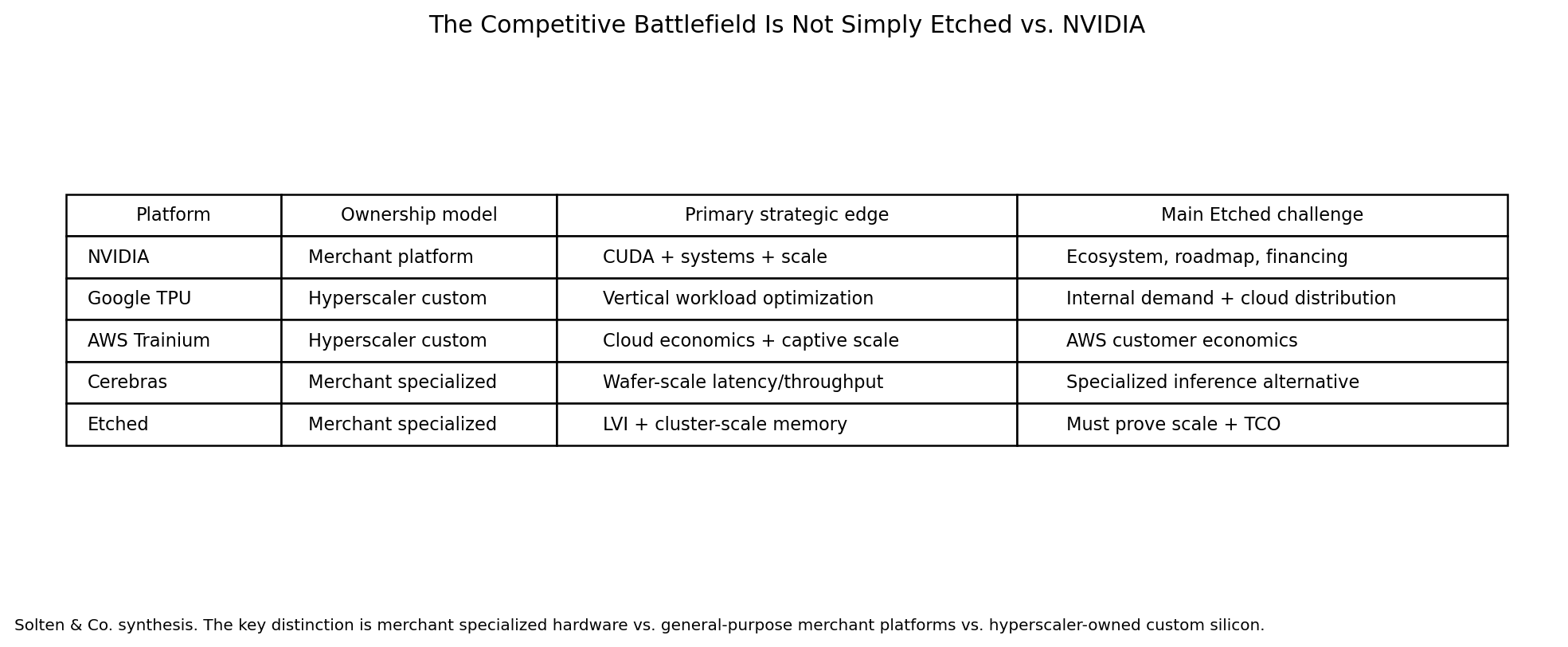
This framework separates merchant general-purpose platforms, hyperscaler-owned custom silicon and merchant specialized architectures. Etched’s strategic opening exists only if a meaningful customer segment wants hyperscaler-like specialization without owning a hyperscaler-scale internal silicon program.
The lazy framing is “Etched versus NVIDIA.” The real market is more complicated.
NVIDIA remains the dominant reference platform because it combines high-performance accelerators with CUDA, networking, systems, enterprise software, developer tooling, financing relationships and an enormous installed base. NVIDIA reported fiscal 2026 revenue of approximately $216 billion, with data-center growth driven by AI. Its gross margins remain above 70%, which demonstrates the economic value of platform control.
But NVIDIA is facing competition from several directions.
Hyperscaler custom silicon. Google TPUs, AWS Trainium, Microsoft Maia and Meta MTIA are increasingly important because the largest buyers have enough workload volume to justify architecture-specific optimization. Google and Broadcom have extended TPU collaboration through 2031, and Google is expanding external TPU distribution. AWS has made Trainium central to major OpenAI and Anthropic compute relationships.
Merchant accelerators. AMD remains the largest conventional GPU alternative. Cerebras uses wafer-scale processors and is explicitly targeting fast inference. Its newly announced CS-4 system illustrates how quickly the specialized-inference market is moving.
Specialized architectures. Groq demonstrated demand for low-latency inference and ultimately entered a major technology relationship with NVIDIA, a reminder that incumbent responses can include acquisition, licensing and ecosystem absorption rather than only price competition.
Other startups and new architectures. Tenstorrent, SambaNova, d-Matrix, Furiosa and others continue to pursue different combinations of programmability, memory architecture, inference efficiency and system design.
Etched is therefore competing on multiple dimensions:
- tokens per dollar;
- tokens per watt;
- latency;
- throughput;
- programmability;
- model compatibility;
- memory capacity and bandwidth;
- interconnect performance;
- rack-level deployment complexity;
- supply availability;
- software maturity;
- customer switching cost;
- production scale.
The important market question is not whether one architecture wins universally. Independent accelerator research increasingly suggests that workload characteristics determine the optimal hardware. The likely market structure is heterogeneous.
Etched’s opportunity is to own a sufficiently valuable portion of that heterogeneity.
Market Structure: The Inference Economy Is Becoming Its Own Industry
The shift from training to inference is central to the Etched thesis.
Training creates frontier capability, but inference monetizes that capability. Every user query, coding-agent step, enterprise workflow and autonomous tool call creates recurring inference demand. As agentic systems perform longer reasoning chains and call other models or software repeatedly, the number of inference operations per unit of useful work can rise dramatically.
NVIDIA itself now describes inference as the dominant AI workload. The company’s fiscal 2026 annual materials state that inference has overtaken training as the primary workload and emphasize the changing economics of AI as models move into large-scale use.
This shift matters because inference rewards different optimization choices than training.
Training values flexibility, enormous distributed scale and rapid support for new model operations.
Inference can reward specialization when workloads are repeated at high volume. Once a model architecture is stable enough, purpose-built silicon can theoretically remove general-purpose overhead and optimize memory, scheduling and power around the real workload.
That creates a structural opening for companies like Etched.
But the same economics also motivate every hyperscaler to build custom silicon internally. Etched must therefore prove that a merchant specialized platform can compete not only with NVIDIA but with customers’ own chips.
Industry Impact: First-, Second- and Third-Order Effects
First-order effect: more credible competition in inference accelerators.
A working Etched system with a production customer increases pressure on NVIDIA and other accelerator vendors to compete on inference-specific economics rather than only headline training performance. It also gives AI labs and cloud providers another procurement option.
Second-order effect: greater bargaining power for large compute buyers.
Even if Etched never takes dominant market share, credible alternatives can influence NVIDIA pricing, supply terms and roadmap priorities. Large buyers gain leverage when they can move marginal inference workloads to specialized systems.
Second-order effect: more fragmentation in the software stack.
Every new accelerator creates integration cost. Model runtimes, compilers, kernels, observability, orchestration and deployment tooling must support heterogeneous systems. This creates opportunity for software layers that abstract hardware differences — but also raises switching costs for customers.
Second-order effect: more pressure on custom silicon economics.
If Etched can offer hyperscaler-like specialization without requiring a customer to design its own chip, it creates a new strategic option between buying NVIDIA and building an internal ASIC program.
Third-order effect: semiconductor value may shift from chips toward integrated inference systems.
Etched’s own evolution suggests that the economic unit is moving upward from the accelerator die to the rack or cluster. Memory, networking, cooling, power delivery, software and manufacturing become part of competitive differentiation.
Third-order effect: capital intensity spreads downstream.
If specialized inference becomes a major infrastructure category, large venture-funded companies may need hundreds of millions or billions of dollars to finance fabrication, inventory, systems and customer deployments before revenue scales. The distinction between venture capital and industrial project finance begins to blur.
Broader Economic Implications
Etched is one small company relative to the global semiconductor market, so macro claims should be restrained. But the financing contributes to several larger patterns.
AI is becoming more industrial. Capital is flowing not only into software but into fabs, packaging, memory, data centers, power, cooling, networking and purpose-built systems.
Inference efficiency has downstream economic significance. If specialized hardware materially lowers the cost per useful token, then applications that are currently uneconomic can become viable. That can affect pricing for AI software, enterprise automation and agentic workloads.
Hardware competition may also shift capital allocation. The stronger the evidence that inference supports multiple architectures, the more venture and growth capital may move toward specialized silicon, memory systems, networking and infrastructure software.
At the same time, the market risks overinvestment. High private valuations and massive compute commitments can create excess capacity if model monetization fails to scale at the pace assumed by infrastructure investors.
Risks to Etched
Technology risk. Performance claims may narrow under independent testing or production conditions. Different workloads may reduce the theoretical advantage of specialization.
Architecture risk. Although Etched’s 2026 system appears broader than the original transformer-only thesis, rapid changes in model architecture can still invalidate hardware assumptions.
Software risk. NVIDIA’s most durable moat is not only silicon. CUDA, libraries, tooling, developer familiarity and system integration create powerful switching costs.
Manufacturing risk. First-pass silicon is a major achievement but does not guarantee high-yield volume production across multiple generations.
Supply-chain risk. Etched depends on advanced foundry capacity, packaging, memory and other constrained semiconductor inputs.
Execution risk. Scaling from a few racks to gigawatt-scale deployments is an industrial challenge substantially harder than producing working A0 silicon.
Customer concentration risk. Only Jane Street is currently publicly identified. More than $1 billion in contracts could still be concentrated in a small number of counterparties.
Capital risk. Building inventory and production capacity may require further large financings before cash generation becomes self-sustaining.
Valuation risk. At $21 billion, execution disappointments can create severe private-market repricing even if the company remains technologically viable.
Incumbent-response risk. NVIDIA has the resources to respond through product acceleration, pricing, financing, software integration, partnerships or acquisition/licensing strategies.
Hyperscaler risk. The largest potential customers may prefer their own TPU, Trainium, Maia or MTIA systems rather than buying from a merchant startup.
Risks to Investors
The current round has unusually high expectations embedded in the entry price.
A successful product launch is not sufficient. Investors need Etched to sustain a major competitive position over multiple product generations.
Future dilution could materially raise required exit values. A capital-intensive company may need several more large rounds.
Private-market headline valuation does not disclose preference terms. Investors entering at different rounds may have very different downside protection.
The customer-investor overlap is both strength and risk. Strategic investors can accelerate adoption, but commercial relationships may make market demand appear stronger than it would under purely arm’s-length procurement.
Liquidity is uncertain. An eventual IPO must support a valuation far above current levels for venture-style returns, while strategic acquisition at extreme valuations becomes difficult because only a small set of buyers could finance it and antitrust considerations may constrain some obvious acquirers.
Risks to the Industry
Large financings can accelerate competitive innovation, but they can also distort market behavior.
Capital crowding. Well-funded hardware companies can bid aggressively for scarce semiconductor talent and supply capacity, raising costs for smaller entrants.
Supply concentration. More accelerator designs still depend on a small number of foundries, advanced packaging providers and memory suppliers.
Architecture fragmentation. Heterogeneous hardware can improve efficiency but increase software and operational complexity across the ecosystem.
Overcapacity. If inference demand disappoints, capital-intensive accelerator and data-center investments could create stranded or underutilized assets.
Synchronized assumptions. Many current AI infrastructure investments depend on the same premise: rapidly rising inference demand and sustained willingness to pay. Correlated error in that assumption would affect labs, clouds, chipmakers, power developers and infrastructure financiers simultaneously.
Scenario Analysis
Base Case
Etched successfully ramps production, converts a meaningful portion of its current contracts into recognized revenue and demonstrates superior inference economics on selected frontier workloads. It becomes a credible second-source or specialized accelerator supplier for several AI labs, clouds and high-performance enterprises. NVIDIA remains dominant overall, but Etched captures a defensible high-value niche and grows into a major infrastructure company.
Signals supporting this case: several named production customers; independent benchmark validation; repeat orders; evidence of improving gross margins; second-generation silicon delivered on schedule; expansion beyond Jane Street without sacrificing performance.
Upside Case
Inference becomes substantially larger than training in total compute spend, and workloads increasingly reward specialization. Etched’s architecture demonstrates a durable cost and power advantage while its system integration reduces migration friction. Hyperscalers use Etched as a merchant alternative to internal ASIC programs, AI labs adopt the systems at multi-gigawatt scale, and the company becomes an independent platform with economics closer to a leading accelerator vendor than a niche chip supplier.
In this case, a valuation above $100 billion becomes plausible.
Signals supporting this case: multi-gigawatt customer commitments, very strong gross margins, broad model compatibility, major cloud distribution, sustained performance-per-watt advantage over two NVIDIA generations, rapid third-generation product execution.
Downside Case
Etched’s initial systems work but deliver a narrower advantage than expected once real-world utilization, software costs and new NVIDIA platforms are considered. The $1 billion-plus contracts convert slowly, customers retain Etched as experimental capacity rather than core production infrastructure, and hyperscalers prioritize internal silicon. High production spending forces further financing, compressing returns for current investors.
Signals supporting this case: delayed deliveries, limited independent benchmarking, cancellations or contract slippage, continued customer anonymity, heavy pricing discounts, rising inventory, repeated financing before meaningful revenue, slower roadmap execution.
Solten & Co. Thesis
The Etched financing is evidence that the AI accelerator market is moving from a single dominant architecture toward a portfolio of workload-specific compute systems.
The important economic variable is not “Can Etched beat NVIDIA?” in the abstract. It is whether the cost of inference becomes large and repetitive enough that customers are willing to accept hardware and software fragmentation in exchange for materially better tokens per dollar, tokens per watt and latency on specific high-value workloads.
If that threshold has been crossed, Etched does not need to replace NVIDIA. It needs to become economically indispensable for a sufficiently large subset of inference.
The round suggests sophisticated investors believe that subset may be very large.
Counter-Thesis
The strongest counter-thesis is that the market is overestimating the value of specialized silicon while underestimating the value of general-purpose platform integration.
NVIDIA can amortize R&D across a vastly larger installed base, improve hardware every generation, bundle networking and systems, subsidize adoption through financing and maintain developer lock-in through CUDA. Hyperscalers can optimize internally for their own workloads without paying a merchant supplier margin.
Etched therefore occupies a difficult middle position: more specialized and less ecosystem-rich than NVIDIA, but less vertically integrated with end-customer demand than Google or AWS custom silicon.
The company must show that its system-level efficiency advantage is large enough to overcome that structural disadvantage.
Falsification Criteria
The Solten & Co. thesis would weaken materially if several of the following occur:
- independent production benchmarks show only modest total-cost advantage over NVIDIA or hyperscaler alternatives;
- customer contracts fail to convert into deployments and recognized revenue;
- the majority of demand remains concentrated in Jane Street or one or two counterparties;
- new model architectures materially reduce the efficiency of Etched’s hardware approach;
- NVIDIA’s next two platform generations close most of the tokens-per-watt or latency gap;
- Etched requires repeated large financings without corresponding commercial scale;
- software migration becomes a persistent barrier to production adoption;
- hyperscalers refuse to adopt merchant specialized inference hardware because internal chips are economically superior.
Key Unknowns
The public investment case remains constrained by missing information. The highest-value unanswered questions are:
- What is Etched’s recognized revenue today?
- How much of the $1 billion-plus contract value is legally binding and non-cancellable?
- What is customer concentration?
- What is the expected delivery schedule for those contracts?
- What are current and expected gross margins per rack?
- What is actual production yield?
- What is the all-in system cost per token under realistic production workloads?
- How does Etched compare with NVIDIA Blackwell and Vera Rubin under identical model, precision, latency and batch conditions?
- What percentage of workloads can run without material software modification?
- What foundry, HBM and packaging capacity is contractually secured?
- How much additional capital will be required before positive free cash flow?
- What are the preference and governance terms in the latest round?
- How much ownership did Jane Street obtain?
- Which frontier AI companies and cloud providers are under contract?
- What proportion of current contracts relate to first-generation versus future-generation systems?
What to Watch Next
The next six to eighteen months should provide far more information than the financing announcement itself.
The critical signals are:
- additional named customers;
- independent benchmark publication;
- production shipment volume;
- contract conversion to revenue;
- second and third hardware generation milestones;
- hyperscaler adoption;
- broader software ecosystem availability;
- pricing disclosure or customer total-cost evidence;
- manufacturing scale and yield;
- additional fundraising;
- changes in NVIDIA inference pricing and roadmap;
- competitive launches from Cerebras, AMD, AWS, Google and other accelerator providers;
- any evidence that Etched is becoming a standard merchant alternative rather than a specialist system for a narrow set of customers.
Research Exhibits
Exhibit 1 — Etched Valuation Trajectory
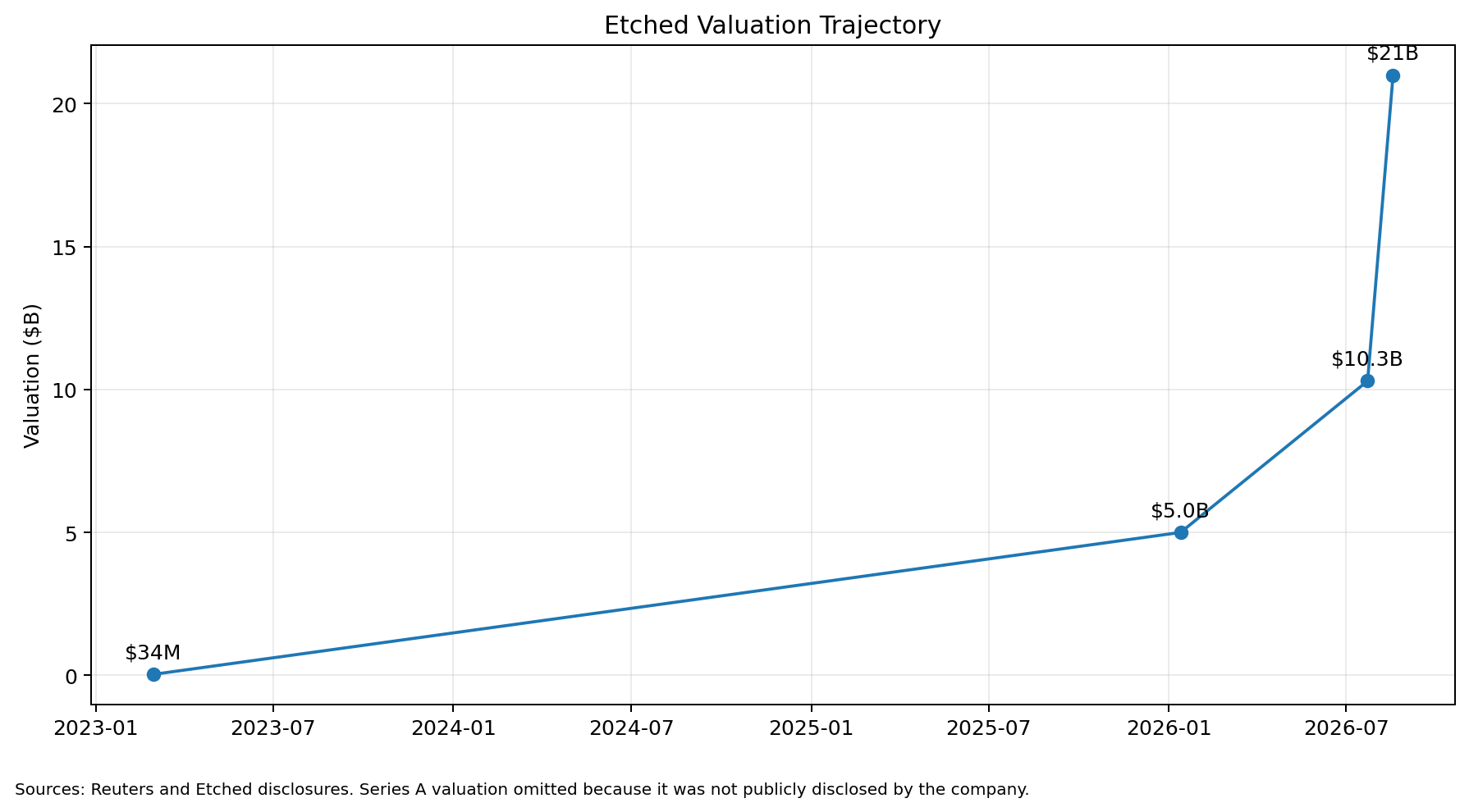
The valuation trajectory illustrates how rapidly market expectations have changed. The Series A valuation is intentionally omitted because Etched did not publicly disclose it at the time.
Exhibit 2 — Known Financing Rounds
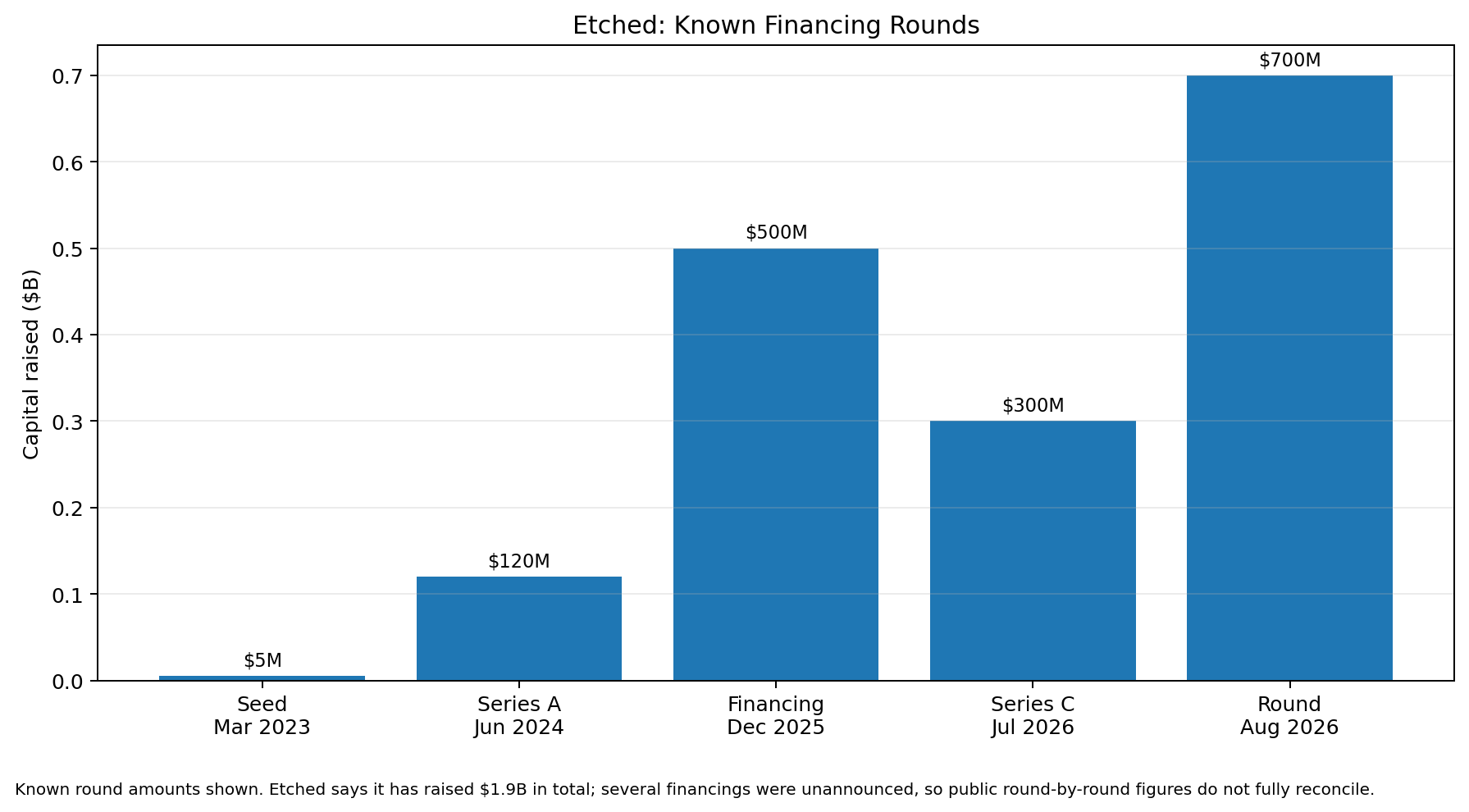
Public financing records do not fully reconcile to Etched’s stated $1.9 billion total because several rounds were unannounced and historical totals were rounded. The correct approach is to preserve that uncertainty rather than manufacture precision.
Exhibit 3 — What a $21 Billion Entry Valuation Implies
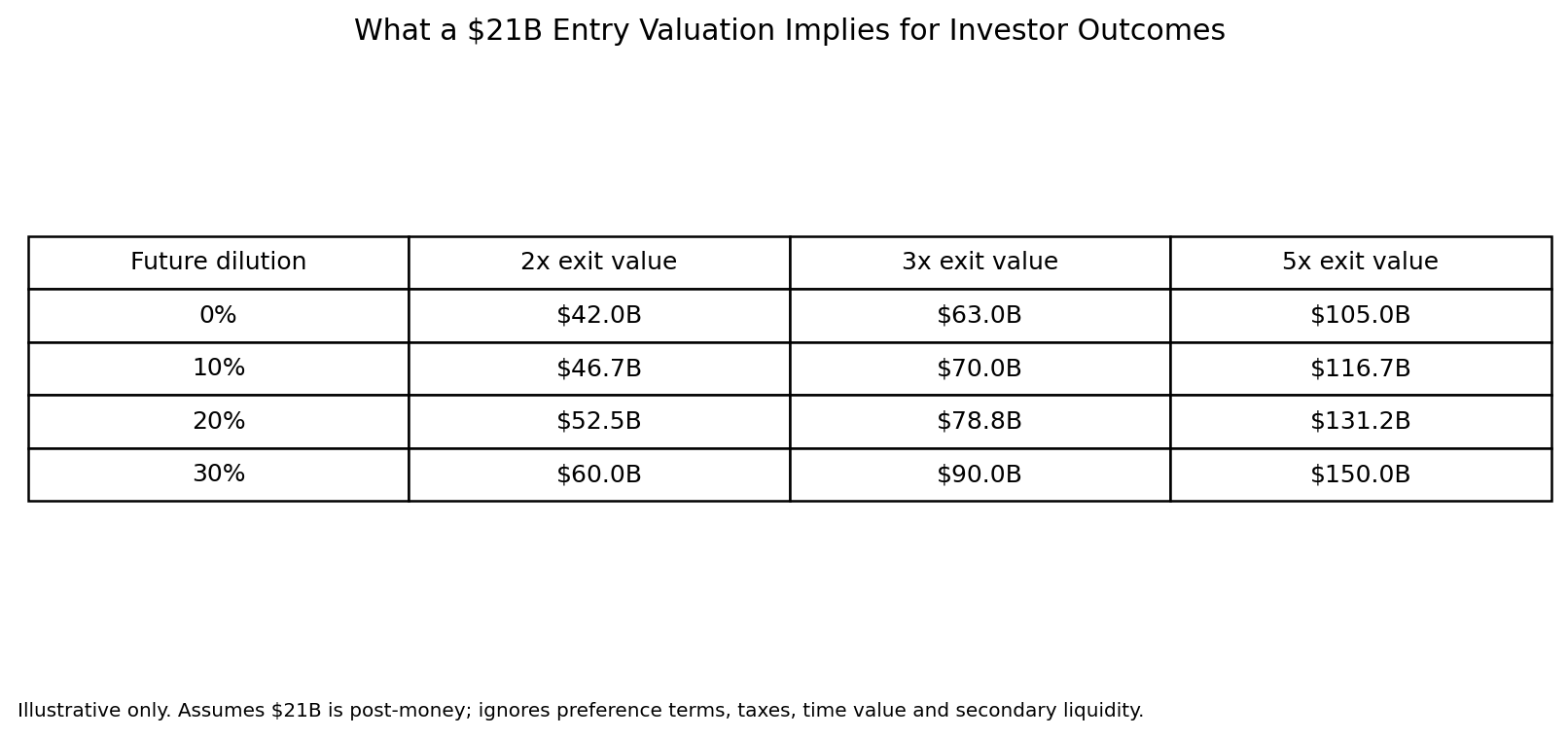
This is an illustrative return-hurdle model, not a valuation forecast. It demonstrates how future dilution raises the exit value required for current investors to achieve venture-style returns.
Sources & Evidence
Primary / company sources
Etched — Frontier Inference Clusters, June 30, 2026
https://www.etched.com/progress/frontier-inference-clusters
Etched — company website and leadership materials
Etched — $300M financing at $10.3B valuation, July 23, 2026
Etched — $700M financing at $21B valuation / first Jane Street delivery, August 18, 2026, company release syndicated by AIwire
CoreWeave — Jane Street $6B cloud agreement and $1B equity investment, April 15, 2026
https://www.coreweave.com/news/jane-street-signs-6-billion-ai-cloud-agreement-with-coreweave
NVIDIA — FY2026 annual results
NVIDIA — FY2026 Form 10-K
https://www.sec.gov/Archives/edgar/data/1045810/000104581026000021/nvda-20260125.htm
Google Cloud — Anthropic expands TPU usage, April 6, 2026
https://www.googlecloudpresscorner.com/2026-04-06-Anthropic-Expands-Use-of-Google-Cloud-and-TPUs
High-quality reporting / research
Reuters — AI chip startup Etched doubles valuation to $21 billion in under a month, August 18, 2026
Reuters — Etched raises $120 million to develop specialized chip, June 25, 2024
Reuters — Jane Street signs $6B AI cloud deal with CoreWeave, April 15, 2026
Reuters — Cerebras launches new inference server system, August 19, 2026
Reuters — Broadcom signs long-term Google custom AI chip agreement, April 6, 2026
TechCrunch — Etched Series C at $10.3B valuation, July 23, 2026
TechCrunch — Etched Series A / transformer-only strategy, June 25, 2024
https://techcrunch.com/2024/06/25/etched-is-building-an-ai-chip-that-only-runs-transformer-models/
Primary Venture Partners — Etched Series A thesis / company history
https://www.primary.vc/articles/etcheds-series-a-to-revolutionize-ai-hardware
Academic research — The xPU-athalon: Quantifying the Competition of AI Acceleration, 2026
https://arxiv.org/abs/2604.10852
Methodological Note
This report distinguishes disclosed facts, reported terms, estimates and Solten & Co. interpretation.
DISCLOSED FACT — directly supported by a company, regulatory or authoritative primary source.
REPORTED TERM — reported by a credible secondary source but not independently disclosed in full by the relevant company or counterparty.
ESTIMATE — an analytical calculation based on incomplete public data. Assumptions are stated where material.
SOLTEN & CO. INTERPRETATION — our synthesis or inference from the evidence.
The report does not treat contract value as revenue, valuation as enterprise value, or headline round size as sufficient evidence of ownership. Private-company financial statements, cap-table terms, contract schedules and detailed customer economics are not publicly available. Valuation return scenarios are illustrative and do not represent an investment recommendation.
About Solten & Co.
Solten & Co. is an independent research and analysis firm focused on the AI economy, with deeper research emphasis on AI infrastructure, Physical AI, robotics and autonomous systems. We study the technologies, companies, markets, transactions and capital structures shaping the next phase of AI.
Need an independent perspective?
Solten & Co. provides independent research and analytical support for investors and decision-makers evaluating companies, markets and investment opportunities across the AI economy.
Discuss a research question · Discuss an investment opportunity · Request independent analysis