Solten & Co. Research Report
Published/updated: August 20, 2026
Research universe: AI Infrastructure / Energy / Data Centers / Capital & Deals
Research Snapshot
Research type: Flagship Research Report
Evidence cut-off: August 20, 2026
Estimated reading time: ~30 minutes
Executive Summary
The AI infrastructure race is moving into a new phase. For the past several years, the scarcest strategic inputs were advanced accelerators, high-bandwidth memory, networking equipment and the capital required to buy them. Those constraints have not disappeared. But a more physical bottleneck is moving upstream: the ability to energize a data center at the scale and on the timetable that AI developers now require.
The change is visible in the numbers. Lawrence Berkeley National Laboratory’s June 2026 update estimates that U.S. data centers could consume 11.8% of total U.S. electricity in 2030 in its reference case, with sensitivity scenarios ranging from 9.5% to 15.3%. The same report estimates roughly 148 GW of interconnection capacity could be required for data centers by 2030 under a 50% average utilization assumption. AI servers are the dominant driver of the increase.
That load is arriving much faster than the infrastructure built to serve it. An advanced data center can be developed in roughly two to three years, while Berkeley Lab’s latest national interconnection analysis shows that the median path from a generation interconnection request to commercial operation now exceeds five years in the regions with available data. The result is a structural timing mismatch: compute capital can be committed faster than reliable power can be connected.
This changes what “capacity” means in AI infrastructure. A site with land, fiber and a data-center shell is not necessarily a usable AI asset. The economically scarce object is increasingly an energization right: a credible path to a specific quantity of power, at a specific location, by a specific date, with acceptable reliability, cost and curtailment terms. In markets where grid capacity is tight, queue position, executed utility agreements, transmission access and generation arrangements can become as strategically important as the servers themselves.
Virginia offers a revealing leading indicator. Dominion Energy says it has assigned energization dates through 2031 to 25 GW of new data-center projects for which it has current or soon-to-be-connected capacity. Another 45 GW of proposed new data-center projects do not yet have future connection dates. At the same time, the Virginia State Corporation Commission has created a separate large-load rate class that includes long-term minimum obligations, minimum monthly transmission and distribution charges, and potential collateral requirements. The power contract is beginning to resemble an infrastructure commitment rather than a simple utility bill.
Grid operators are adapting as well. PJM spent 2025–2026 developing special frameworks for large load additions, including “connect-and-manage” concepts and possible pathways for customers that bring new generation or accept curtailment. ERCOT introduced a batch process for loads of 75 MW or greater so the system can assess large projects collectively rather than one by one. In other words, data-center interconnection policy is becoming part of AI industrial policy.
The strategic response from technology companies is increasingly visible in power procurement. Microsoft’s 20-year agreement with Constellation supports the restart of the 835 MW Crane Clean Energy Center. Google’s agreement with Kairos Power creates a path to up to 500 MW of advanced nuclear capacity by 2035, with the first deployment targeted for 2030. Meta signed a 20-year agreement supporting 1,121 MW at Constellation’s Clinton plant while separately pursuing new nuclear projects. These transactions should not be read simply as sustainability initiatives. They are long-duration attempts to secure firm power and reduce future energy optionality risk.
The central Solten & Co. conclusion is that the AI infrastructure stack is being reordered. Chips remain essential, but chips depreciate quickly and can be procured from multiple vendors over time. A credible high-voltage interconnection, transmission pathway and firm-power arrangement can take many years to create and may be much harder to replicate. In constrained regions, the most durable infrastructure moat may therefore move from ownership of compute equipment toward control of time-to-power.
Key Findings
- Power is becoming a first-order AI input. Data centers are no longer a marginal electricity category in the United States; the 2030 reference case from Berkeley Lab implies roughly one-eighth of national electricity consumption.
- The critical scarcity is not electricity in the abstract but deliverable electricity at a specific place and time. Grid connection, transmission capacity, transformers, substations, firm generation and queue position determine whether nominal power supply can actually become usable AI capacity.
- AI development and grid development operate on different clocks. Data centers can be built faster than generation and transmission can be interconnected, creating a growing premium on pre-secured energization.
- Virginia shows how energization rights can acquire economic value. Dominion reports 25 GW of new data centers with assigned energization dates and another 45 GW without dates.
- Utility contracts are becoming strategic obligations. Virginia’s new large-load framework requires long contract periods and minimum payments designed to reduce the risk that ordinary ratepayers finance infrastructure for projects that later underutilize or abandon capacity.
- Grid policy is becoming part of AI competitive strategy. PJM and ERCOT are redesigning large-load processes around reliability, curtailment, generation contribution and project readiness.
- Firm power is creating a new class of technology-energy transactions. Nuclear restarts, life extensions, advanced nuclear development, onsite generation and storage are increasingly linked to technology-company load growth.
- Time-to-power may become a valuation variable. Data-center land with an executed path to hundreds of megawatts should not be valued like otherwise similar land with uncertain energization.
- The power bottleneck can reshape geography. AI clusters may migrate toward regions with faster interconnection, surplus generation, expandable transmission, fuel access and flexible large-load rules rather than simply toward historic cloud regions.
- The counter-thesis is meaningful. Better hardware efficiency, lower energy per AI task, load flexibility, grid reform and slower-than-expected project realization could reduce the severity of the bottleneck. The correct thesis is not “the U.S. will run out of electricity,” but that timely, location-specific, reliable capacity is becoming scarce enough to influence AI economics.
Table of Contents
- From GPU Scarcity to Power Scarcity
- The Demand Curve Has Crossed a System Threshold
- The Real Asset Is an Energization Right
- The Time-Scale Mismatch
- Virginia as a Leading Indicator
- Grid Rules Are Becoming AI Industrial Policy
- Power Contracts Are Becoming Strategic Obligations
- Why Firm Power Is Back
- Behind-the-Meter Power: Escape Valve, Not Free Lunch
- Flexibility Becomes a Currency
- The Capital Structure of AI Power
- Time-to-Power as a Valuation Variable
- Winners, Losers and Second-Order Effects
- Solten & Co. Thesis, Counter-Thesis and Falsification
- What to Watch Next
Sources & Evidence
Methodological Note
About Solten & Co.
Scope & Methodology
Research question. This report examines whether electricity infrastructure is becoming a binding strategic constraint on AI development in the United States, and what that shift means for data-center economics, hyperscaler strategy, utilities, power developers, infrastructure investors and adjacent technology markets.
Scope. The analysis focuses on U.S. data-center electricity demand, generator and large-load interconnection, selected regional examples, firm-power procurement and the financial implications of time-to-power. It does not forecast individual power prices, recommend securities or assume that every announced data-center project will be built.
Evidence hierarchy. Priority is given to Lawrence Berkeley National Laboratory, the International Energy Agency, FERC, PJM, ERCOT, state utility regulators, utilities and direct corporate announcements. Company energy agreements are treated as strategic evidence, not as proof that announced capacity will be delivered on schedule.
Critical limitation. Data-center project pipelines contain duplication, speculative requests and projects that will never reach operation. Electricity-demand forecasts also depend heavily on hardware efficiency, model architecture, utilization, deployment pace and AI adoption. The analysis therefore distinguishes announced load, interconnection capacity, contracted power and realized consumption.
What Changed
The power constraint is not new, but its strategic importance changed sharply in 2025–2026. The IEA estimates that capital expenditure by five major technology companies exceeded $400 billion in 2025 and is expected to rise another 75% in 2026. Its satellite-based tracking indicates that cutting-edge “AI factory” capacity more than tripled in roughly eighteen months. This is industrial expansion at a speed the electricity system was not designed to mirror.
At the same time, the energy intensity of individual AI tasks is falling quickly. The IEA reports at least an order-of-magnitude annual decline in energy per AI task in recent years. That would normally relieve infrastructure pressure. But the mix of work is changing toward reasoning, video and agentic tasks that can consume hundreds or thousands of times more energy than simple text queries, while usage itself is growing rapidly. Efficiency is therefore fighting a rebound effect rather than simply reducing total load.
The newest development is institutional. Large-load connection is no longer being treated as routine utility service. PJM, ERCOT, Virginia regulators and utilities are creating specialized rules around data centers and other large loads because a single project can now resemble a traditional power plant in scale while arriving on a technology-company timetable.
1. From GPU Scarcity to Power Scarcity
The first phase of the generative-AI infrastructure boom was dominated by accelerator scarcity. Access to NVIDIA GPUs became a competitive advantage, cloud capacity was rationed, and startups raised capital partly to secure compute. That framing remains useful, but it is incomplete in 2026.
A GPU cluster is economically useless without power. More importantly, the marginal difficulty of adding power is increasing as cluster size rises. Large AI campuses require substations, transformers, transmission upgrades, cooling systems, backup systems and generation resources capable of supporting loads measured in hundreds of megawatts or multiple gigawatts. The infrastructure problem therefore moves upstream from the server rack into the electricity system.
The IEA’s 2026 analysis highlights the physical intensity of this transition. Between 2020 and 2025, AI-server power density increased roughly eleven-fold, and by 2027 it is expected to rise another four-fold. An advanced rack could reach peak demand comparable to 65 U.S. households. Higher density improves the economics of scarce data-center floor space, but it concentrates power and thermal requirements into a much smaller physical footprint.
The strategic implication is straightforward: the AI industry can manufacture more computational density faster than the grid can manufacture new delivery capacity.
Exhibit 1 — U.S. Data Centers Are Moving From a Large Load to a System-Level Load
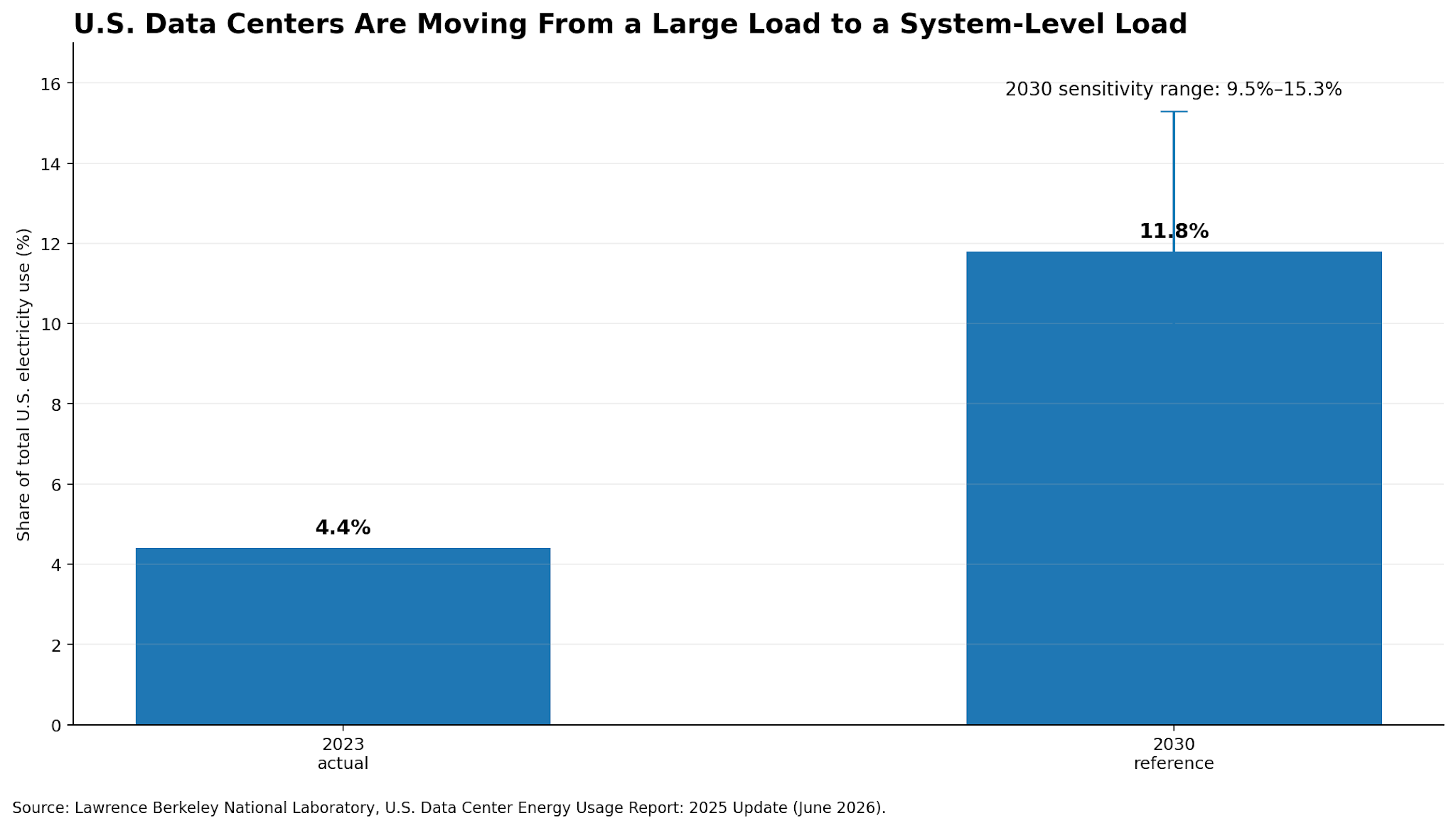
Berkeley Lab’s 2026 update moves the discussion beyond anecdotes. Its reference case reaches 11.8% of total U.S. electricity consumption by 2030, with a 9.5%–15.3% sensitivity range. The report estimates that AI servers account for 84% of projected server energy use and 55% of all projected data-center electricity use by 2030.
That does not mean AI will consume a fixed share regardless of price or infrastructure constraints. It means data centers are now large enough to influence generation planning, transmission investment, rate design and regional resource adequacy.
2. The Demand Curve Has Crossed a System Threshold
Electric systems routinely absorb new industrial loads. What makes AI different is the combination of size, concentration, speed and uncertainty.
Size matters because a single campus can require hundreds of megawatts. Concentration matters because data centers cluster around fiber, existing cloud regions, skilled labor and tax regimes. Speed matters because technology companies can finance and build a campus much faster than a transmission corridor or major generating plant. Uncertainty matters because announced projects can be delayed, resized, duplicated across utility queues or cancelled.
The IEA emphasizes this distinction: globally, data centers remain a modest share of electricity use, but they create outsized local integration challenges because demand is geographically concentrated. This is why national electricity abundance does not solve a local interconnection shortage.
For AI investors, the right question is therefore not “Does the United States have enough electricity?” It is “Can this specific site receive the required power, on the required date, under terms that remain economic if utilization is lower than planned?”
3. The Real Asset Is an Energization Right
In conventional data-center analysis, investors often focus on land, building cost, fiber connectivity, cooling and server economics. The current market adds another asset class: a credible energization pathway.
An energization right is not a formal legal category. It is an analytical way to describe the bundle of permissions, infrastructure and contractual commitments that allow a site to draw meaningful power. It can include utility service agreements, queue position, completed studies, transmission upgrades, substation capacity, generation contracts, transformer procurement and regulatory approvals.
This distinction matters because two sites with identical acreage can have radically different economic value. One may have an executable path to 500 MW in 2028. Another may have theoretical access to a large regional grid but no credible connection date before 2032. The second site is not merely “later.” It may miss an entire hardware and model cycle.
In AI infrastructure, time has unusually high option value. A two-year delay can mean several generations of accelerators, lower model costs, different cooling architectures and changed demand assumptions. That makes a secured energization date economically closer to a scarce real option than to a routine utility connection.
4. The Time-Scale Mismatch
Exhibit 2 — AI Infrastructure Is Being Built on a Faster Clock Than the Grid
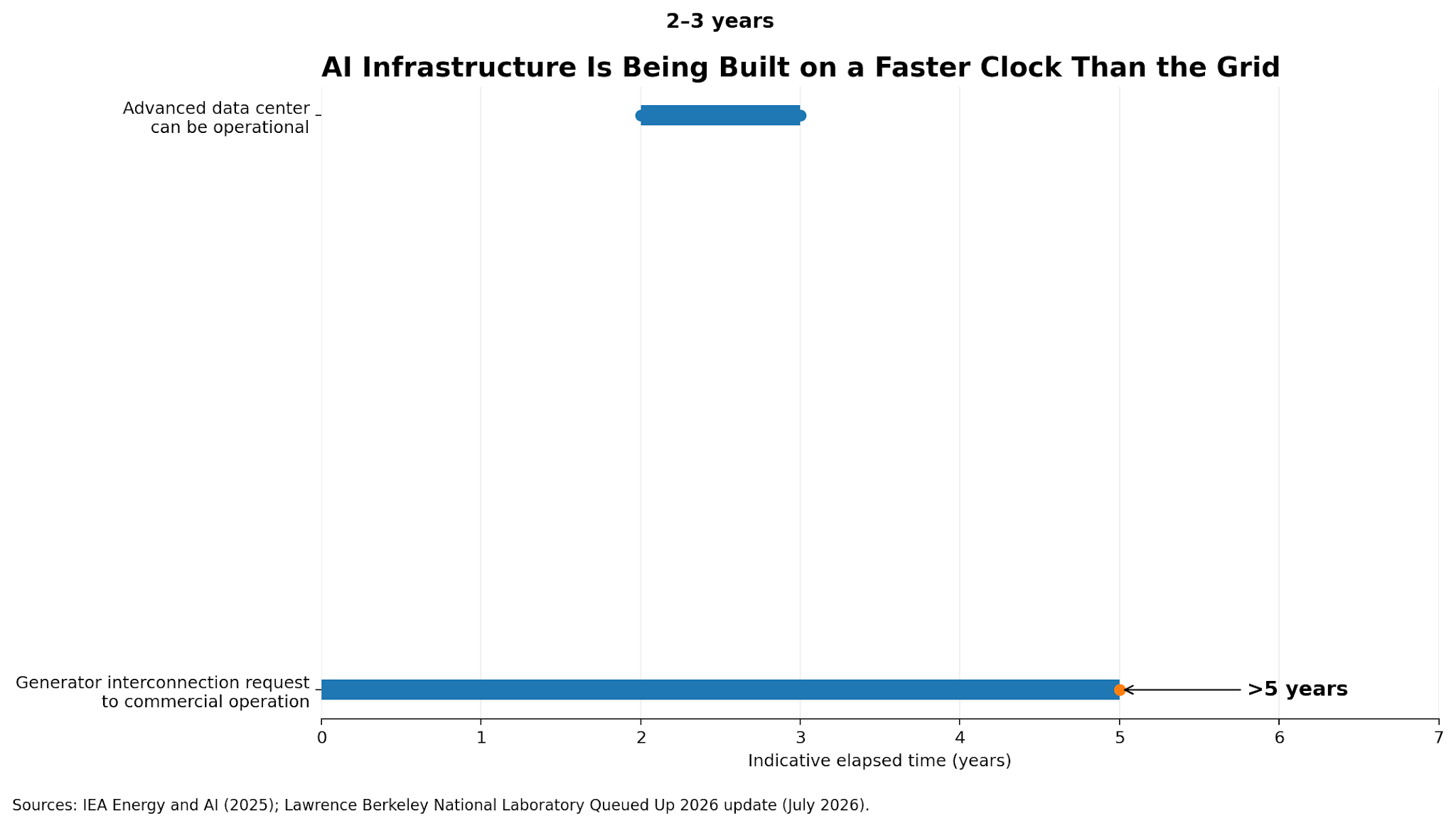
The mismatch is visible in development timelines. The IEA notes that a data center can be operational in roughly two to three years. Berkeley Lab’s July 2026 interconnection update shows that the median duration from generator interconnection request to signed interconnection agreement was well above three years in 2025, while the path to commercial operation exceeded five years in regions with available data.
These are not perfectly comparable processes: one describes building a load asset, the other adding generation. But that is precisely the point. Demand can materialize faster than supply can be studied, permitted, financed, connected and commissioned.
The queue itself is enormous. Berkeley Lab counted 2,061 GW of generation and storage actively seeking U.S. interconnection at the end of 2025. More than 750 GW of requests were withdrawn during the year, and historically only 13% of capacity submitted from 2000–2020 had reached operation by the end of 2025. A large queue therefore does not equal a large pipeline of near-term power.
This is why nominal resource announcements can mislead AI infrastructure investors. A region may have hundreds of gigawatts “in queue” while still lacking enough firm, deliverable capacity for a data-center campus on the required timetable.
5. Virginia as a Leading Indicator
Northern Virginia became the world’s most important data-center market because it combined fiber, cloud-network effects, business density, land development expertise and historically reliable power access. Its current constraints therefore deserve attention as a preview of what can happen elsewhere.
Exhibit 3 — In Virginia, the Scarce Asset Is Increasingly an Energization Date
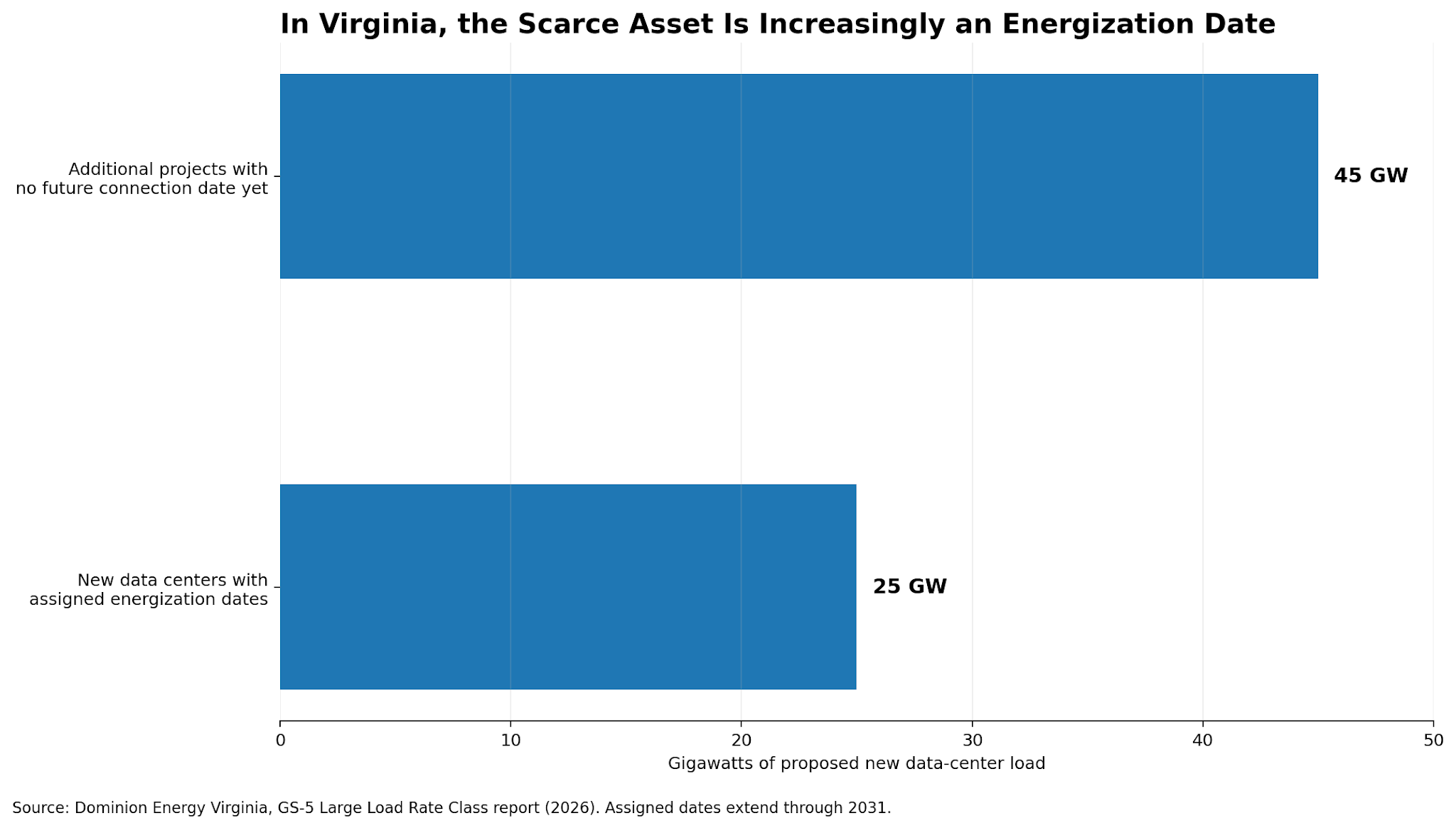
Dominion Energy reports that it has assigned energization dates through 2031 to 25 GW of new data centers where capacity is currently available or expected to be connected. For another 45 GW of proposed new data-center projects, future connection dates have not yet been offered.
The striking point is not that all 70 GW will be built. They almost certainly will not be. The point is that the request pipeline is large enough that the utility must explicitly ration certainty about when projects can connect.
Virginia regulators have also changed the commercial relationship. The State Corporation Commission established a separate GS-5 rate class for large loads. New qualifying customers contracting from 2027 are subject to a minimum 14-year service obligation. Large-load customers are generally required to pay at least 85% of the transmission and distribution costs incurred to serve them each month regardless of actual usage, and some customers may need to provide collateral covering a substantial portion of minimum charges.
This is economically important. Utilities are effectively saying: if the grid makes long-lived investments for an AI campus, the customer must assume part of the stranded-asset risk.
6. Grid Rules Are Becoming AI Industrial Policy
When connection to the grid determines where AI infrastructure can be built, interconnection rules become a competitive-policy variable.
PJM, the largest U.S. regional transmission organization, initiated an accelerated process in 2025 to address large load additions and spent 2026 developing reliability-focused solutions. One direction is a “connect-and-manage” framework in which certain large loads could connect before all necessary system upgrades are complete if they accept curtailment or otherwise operate within reliability limits. PJM has also explored distinctions between loads that bring new generation and those that do not.
ERCOT moved in a different but related direction. In June 2026, Texas regulators approved “Batch Zero,” a process that groups qualified large loads of 75 MW or greater so ERCOT can assess their combined system impact, allocate available capacity and identify transmission needs. The logic resembles modern generator-queue reform: study projects as a portfolio rather than allowing a flood of individually evaluated requests to overwhelm the system.
These changes create strategic questions for AI operators. Is a flexible connection better than waiting years for fully firm service? Is building or contracting new generation worth faster connection? How much curtailment can a training cluster tolerate? Can inference workloads be shifted geographically or temporally? The answer will vary by workload.
Grid design is therefore becoming part of systems architecture.
7. Power Contracts Are Becoming Strategic Obligations
AI companies are already accustomed to large, long-term compute commitments. The energy layer is developing similar characteristics.
A multi-year power arrangement can lock in access to scarce capacity, support financing of new generation and improve certainty for a data-center build. But it also creates risk if model economics, hardware efficiency or demand growth change faster than expected.
The Virginia GS-5 structure makes the analogy explicit. Minimum payment obligations and long contract terms transform electricity from a fully variable operating cost into something closer to a quasi-fixed strategic commitment. The customer is not legally issuing debt, but economically it may be assuming a long-duration obligation tied to infrastructure that was built for its anticipated load.
This mirrors a broader pattern already visible in AI compute contracts: the industry is trading future flexibility for present capacity.
8. Why Firm Power Is Back
Renewables remain essential to data-center power procurement, but very large AI loads place a premium on firm capacity: electricity that can be delivered reliably across hours and seasons, not merely matched annually through renewable-energy certificates.
The strategic value of firm power helps explain the new technology-company interest in nuclear energy.
Microsoft / Constellation. A 20-year power purchase agreement supports the restart of the former Three Mile Island Unit 1 as the Crane Clean Energy Center, expected to add approximately 835 MW of carbon-free generation to the grid.
Google / Kairos Power. Google and Kairos created a multi-plant development agreement for up to 500 MW of advanced nuclear generation by 2035, with the first deployment targeted for 2030.
Meta / Constellation. Meta signed a 20-year agreement supporting continued operation of the 1,121 MW Clinton Clean Energy Center beginning in 2027, while separately pursuing new nuclear capacity through a broader request-for-proposals process.
These transactions are structurally different and should not be added together as if they were comparable delivered capacity. Some preserve existing plants, some restart retired assets, and some attempt to commercialize new reactor designs. What they share is the willingness of technology companies to make long-duration commitments to power infrastructure because future firm capacity has strategic value.
The energy company is becoming part of the AI supply chain.
9. Behind-the-Meter Power: Escape Valve, Not Free Lunch
Slow grid connections are pushing some developers toward onsite or behind-the-meter generation. The attraction is obvious: if the grid cannot deliver power quickly enough, build generation closer to the load.
The IEA’s 2026 work identifies onsite natural-gas generation as an emerging U.S. data-center response and notes that a meaningful share of tracked projects has already begun land clearing or construction. But onsite generation does not eliminate infrastructure constraints; it changes them.
A reliable isolated system needs redundancy. The IEA estimates that reliable onsite gas generation for critical, variable data-center load may require 30%–70% overbuilding relative to demand. Developers then face turbine availability, gas-pipeline capacity, emissions permitting, maintenance, noise, local opposition and financing requirements.
Behind-the-meter power is therefore not “free from the grid.” It is a substitution of one infrastructure stack for another.
10. Flexibility Becomes a Currency
The easiest data-center load for a power system to serve is not necessarily the smallest. It is the load that can adapt when the system is stressed.
AI infrastructure has several potential flexibility levers: delaying non-urgent training runs, shifting training across regions, modulating batch inference, using batteries for short-duration support, operating backup or onsite generation, and designing software to move work between facilities.
The IEA estimates that 20–25 GW of battery storage could be installed in data centers globally by 2030. If appropriately controlled and compensated, some of that storage can support both the facility and the wider grid.
This creates a new trade: faster grid access in exchange for operational flexibility. The emerging PJM connect-and-manage concept illustrates the direction. A data center that can curtail during limited system events may be economically easier to connect than one demanding fully firm, inflexible capacity from day one.
For AI architects, resilience and electricity-market participation may therefore become part of workload orchestration.
11. The Capital Structure of AI Power
Power scarcity changes capital requirements across the AI value chain.
First, data-center developers may need to finance substations, transmission upgrades, generation assets and long-lead electrical equipment earlier in the project cycle.
Second, utilities require greater certainty that large-load customers will actually materialize. Minimum contracts, collateral and readiness milestones transfer more development risk back to the customer.
Third, generation developers gain a new class of anchor offtaker. A creditworthy technology company willing to sign a long-term agreement can make a nuclear restart, gas plant, renewable project, storage installation or advanced-energy demonstration financeable.
Fourth, private infrastructure capital moves closer to AI economics. Investors financing generation and grid assets increasingly need a view on model demand, data-center utilization and hyperscaler capital spending because those variables determine whether the load supporting the infrastructure remains durable.
The separation between “technology investing” and “energy infrastructure investing” is becoming less useful.
12. Time-to-Power as a Valuation Variable
The most important investment implication may be a change in how AI infrastructure assets are valued.
A traditional data-center valuation can emphasize leased megawatts, utilization, rent, replacement cost, tenant quality and cap rates. In the AI era, investors may need to add a more explicit measure: time-to-power certainty.
Consider two otherwise similar development sites:
- Site A has land, fiber, permits and an executed utility pathway to 300 MW by 2028.
- Site B has cheaper land and excellent fiber but no credible energization date before 2031.
The difference is not simply three years of lost rent. Site A can host hardware generations, model launches and customer demand that Site B may never capture. It can also give the tenant negotiating leverage in compute procurement because the limiting input has already been secured.
This suggests a new hierarchy of AI infrastructure assets:
- Powered and operating capacity.
- Contracted capacity with high-confidence energization dates.
- Advanced-stage capacity with identified upgrades and generation.
- Speculative powered-land claims without firm delivery dates.
- Land with only conceptual access to future grid capacity.
Markets that fail to distinguish these categories risk overvaluing “gigawatts” that are not economically deliverable.
13. Winners, Losers and Second-Order Effects
Potential winners
Existing firm generation. Nuclear plants, efficient gas generation, hydro and other reliable assets gain strategic value when power becomes scarce.
Utilities and transmission developers that can add capacity quickly. Regions able to plan and build credible infrastructure can attract high-value AI investment.
Electrical equipment suppliers. Transformers, switchgear, power electronics, turbines, cooling and storage become critical links in the AI supply chain.
Data-center developers with real interconnection rights. A credible power position can differentiate otherwise commoditized real estate.
Flexible AI operators. Companies able to shift workloads, use storage or tolerate curtailment can monetize flexibility through earlier or cheaper connections.
Potential losers
Speculative data-center land. Sites marketed around theoretical future power may be repriced as buyers demand harder evidence of energization.
Inflexible large loads. Customers requiring fully firm service at all times may face higher connection costs and longer delays.
Ratepayers if cost allocation is poorly designed. If utilities build expensive infrastructure for projects that later disappear, stranded costs can shift to other customers. This risk is precisely why new large-load tariffs are emerging.
AI projects with mismatched commitments. A company can over-contract both compute and power if demand or monetization fails to scale.
Second-order effects
Power constraints can alter AI geography. Regions with available generation, fuel, transmission and faster permitting may gain share from established hubs. They can also change semiconductor economics: efficiency per watt becomes more valuable when the bottleneck is electricity rather than chip supply alone.
Third-order effects reach industrial policy. Governments increasingly face trade-offs among data centers, manufacturing, household affordability, electrification and grid reliability. Decisions about who pays for new generation and transmission can influence where the next AI clusters are built.
14. Solten & Co. Thesis, Counter-Thesis and Falsification
Solten & Co. Thesis
The durable bottleneck in frontier AI infrastructure is moving upstream from accelerator procurement toward the ability to secure and energize large quantities of power on a predictable timetable. As this happens, queue position, utility contracts, transmission access, firm generation and load flexibility acquire strategic and financial value. In constrained regions, time-to-power becomes a competitive moat.
Counter-Thesis
The market may be extrapolating peak infrastructure demand too aggressively. Energy efficiency per AI task is improving extremely quickly. Specialized chips, better cooling, higher utilization, workload routing and lower-cost models can reduce power per unit of useful output. Many announced data-center projects will never be built. Grid reform can accelerate interconnection, and flexible loads can reduce the requirement for new firm capacity. If AI monetization grows more slowly than infrastructure commitments, today’s perceived power scarcity could turn into localized overcapacity.
Falsification Criteria
The thesis would weaken materially if several of the following occur:
- Berkeley Lab’s U.S. data-center electricity-demand trajectory is repeatedly revised sharply downward because AI-server deployments or utilization disappoint.
- Median generator and large-load interconnection timelines fall enough that power no longer constrains site delivery.
- Major data-center markets develop large surplus generation and transmission capacity without materially higher customer costs.
- AI efficiency gains consistently outpace growth in model usage and capability, reducing aggregate electricity demand.
- Large-load queues experience very high cancellation rates without corresponding executed projects, revealing much of the apparent scarcity as speculative duplication.
- Corporate firm-power agreements fail to expand beyond a small number of flagship transactions.
- Utilities stop requiring special tariffs, minimum obligations or collateral because stranded-asset risk proves immaterial.
15. What to Watch Next
Data-center electricity share. Track the 2026 Berkeley Lab reference case against actual server shipments, utilization and regional load.
Energization queues. The ratio of projects with assigned connection dates to projects merely requesting capacity may become more informative than headline gigawatts.
Large-load tariff design. Watch minimum contract terms, collateral, cost allocation and curtailment rules across Virginia, Texas, PJM states and other fast-growing markets.
Bring-your-own-generation frameworks. A wider use of customer-supported generation would strengthen the thesis that power procurement is moving inside AI infrastructure strategy.
Nuclear execution. Restarts, uprates and advanced-reactor milestones matter more than announcement volume. Delivery schedule is the key evidence.
Onsite gas and storage. Growth would indicate that developers are willing to pay a premium to bypass grid timing constraints.
Transformer and turbine lead times. If these equipment bottlenecks remain severe, nominal generation investment may still fail to translate into rapid energization.
Geographic migration. Watch whether new AI campuses shift toward regions with faster time-to-power even when those regions are less established as cloud hubs.
Power intensity per useful AI outcome. The long-term balance depends on whether efficiency gains outrun the growth in reasoning, agentic and multimodal workloads.
Sources & Evidence
Primary / authoritative research and system sources
Lawrence Berkeley National Laboratory — United States Data Center Energy Usage Report: 2025 Update, June 2026
https://datacenters.lbl.gov/publications/united-states-data-center-energy-2025
Lawrence Berkeley National Laboratory — Queued Up / U.S. generator interconnection update, July 1, 2026
International Energy Agency — Key Questions on Energy and AI, April 16, 2026
https://www.iea.org/reports/key-questions-on-energy-and-ai
International Energy Agency — Energy and AI, April 2025
https://www.iea.org/reports/energy-and-ai
Federal Energy Regulatory Commission — Order No. 2023, Generator Interconnection Reforms
https://www.ferc.gov/explainer-interconnection-final-rule
PJM — Critical Issue Fast Path: Large Load Additions
https://www.pjm.com/committees-and-groups/cifp-lla
PJM — Connect and Manage Senior Task Force
https://www.pjm.com/committees-and-groups/task-forces/camstf
ERCOT — Large Load Integration / Batch Zero
https://www.ercot.com/services/rq/large-load-integration
ERCOT — PUCT Approves Batch Zero Process, June 18, 2026
https://www.ercot.com/news/release/06182026-puct-approves-ercots
Virginia State Corporation Commission — Data Center Initiatives / GS-5 large-load framework
https://www.scc.virginia.gov/about-the-scc/scc-facts/
Dominion Energy Virginia — Meeting the Demands for Large-Load Customers, 2026
https://sustainability.dominionenergy.com/GS-5%20Large%20Load%20Rate%20Class%20Report.pdf
Selected corporate firm-power signals
Constellation — Microsoft / Crane Clean Energy Center, September 20, 2024
Google — Kairos Power advanced nuclear agreement, October 14, 2024
Kairos Power — Google partnership / 500 MW deployment pathway
https://www.kairospower.com/google
Meta — Constellation nuclear agreement, June 3, 2025
https://about.fb.com/news/2025/06/meta-constellation-partner-clean-energy-project/
Methodological Note
Electricity-demand forecasts, data-center pipelines and interconnection queues should not be treated as committed realized capacity. This report intentionally separates electricity consumption, requested interconnection capacity, announced projects, assigned energization dates, executed power contracts and operating generation. Quantities from different categories are not added together.
The term energization right is a Solten & Co. analytical concept, not a regulatory or accounting classification. It describes the economic value of having a credible, sufficiently advanced path to deliver a defined quantity of power to a site by a useful date.
About Solten & Co.
Solten & Co. is an independent research and analysis firm focused on the AI economy, with deeper research emphasis on AI infrastructure, software AI, Physical AI, robotics and autonomous systems. We study the technologies, companies, markets, transactions and capital structures shaping the next phase of AI.
Need an independent perspective?
Solten & Co. provides independent research and analytical support for investors and decision-makers evaluating companies, markets and investment opportunities across the AI economy.
Discuss a research question · Discuss an investment opportunity · Request independent analysis