Solten & Co. Research Report
August 21, 2026
AI Infrastructure · Capital & Deals
Research Snapshot
Research type: Flagship Research Report
Evidence cut-off: August 21, 2026
Estimated reading time: ~30 minutes
Executive Summary
NVIDIA’s strategic position in artificial intelligence is changing again. The company first became indispensable as the dominant supplier of accelerated computing. It then expanded the competitive boundary through CUDA, networking, systems and full-stack AI infrastructure. In 2026, a third layer has become increasingly visible: NVIDIA is using equity capital, credit support, guarantees and partnerships with global asset managers to help finance the infrastructure that buys and deploys NVIDIA compute.
This is not a side activity. On August 10, NVIDIA announced memoranda of understanding with Apollo, BlackRock, Blackstone, Brookfield, Goldman Sachs and KKR to create financing platforms intended to mobilize more than $500 billion of third-party capital for AI infrastructure. NVIDIA described the objective explicitly: turn NVIDIA compute and full-stack AI infrastructure into an investable asset class and create dedicated pools of capital for its ecosystem.
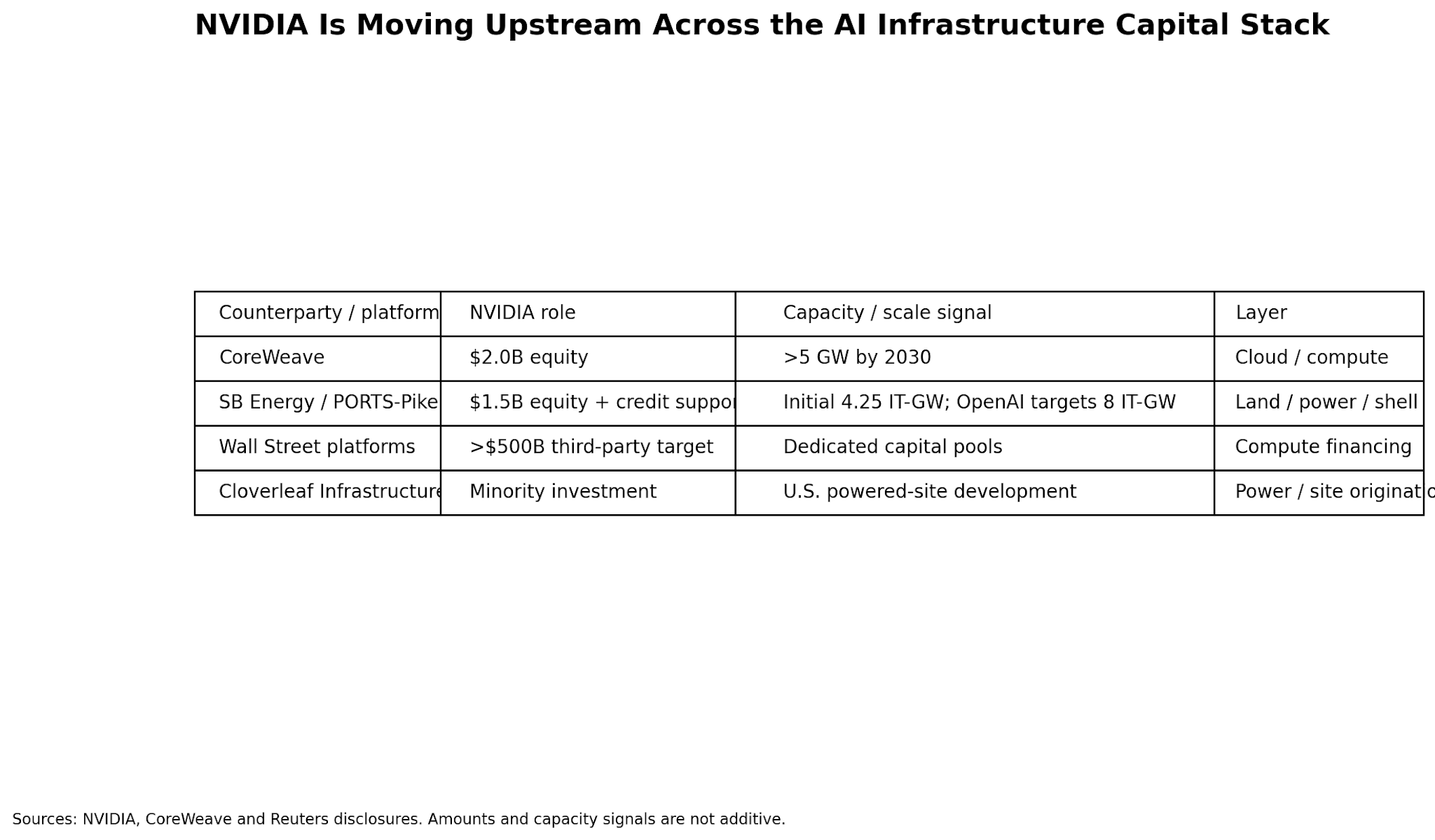
One week later, NVIDIA announced a $1.5 billion investment in SB Energy and credit support for the land, power and shell associated with the initial 4.25 IT-GW at the PORTS-Pike Technology Campus in Ohio. OpenAI has agreed to secure approximately 8 IT-GW at the site. NVIDIA will be the exclusive AI compute infrastructure provider. Four days later, NVIDIA disclosed a minority investment in Cloverleaf Infrastructure, a developer focused on power and sites for data-center projects in the United States.
These transactions extend a pattern already visible in NVIDIA’s relationship with CoreWeave. In January 2026, NVIDIA invested $2 billion in CoreWeave as the companies expanded a relationship designed to support more than 5 GW of AI factories by 2030. NVIDIA’s latest Form 10-Q shows how quickly the financial footprint has grown: non-marketable equity securities increased from $3.24 billion in April 2025 to $42.34 billion in April 2026, while total investment commitments reached $27 billion as of April 26, 2026.
The core Solten & Co. thesis is that NVIDIA is evolving from a semiconductor supplier into a deployment orchestrator. It is not merely selling scarce hardware into demand. It is increasingly helping convert future AI demand into financeable infrastructure projects — and in doing so, it can influence which clouds, data-center developers, energy projects and AI labs reach scale.
That strategy can deepen NVIDIA’s moat. If lenders and infrastructure investors become comfortable underwriting assets around NVIDIA systems, the company gains a financing advantage in addition to a technology advantage. Lower financing friction can accelerate customer buildout, expand the installed base, support CUDA adoption and create additional demand for future NVIDIA generations. The financing mechanism can therefore become self-reinforcing.
But the same mechanism also creates a new risk surface. NVIDIA may increasingly have economic exposure to the success of customers, infrastructure developers and AI demand itself. Guarantees and strategic investments can soften the distinction between independent market demand and supplier-supported demand. If compute remains scarce and utilization stays high, this may look like efficient ecosystem financing. If supply catches up, utilization falls or AI-lab economics disappoint, the residual value of GPU-backed projects and the credibility of compute as collateral could be tested.
The right analytical frame is therefore not simply “circular financing.” That phrase is too broad and often conflates equity investments, customer prepayments, credit guarantees, offtake arrangements and independent third-party debt. The more useful question is: how much of AI infrastructure demand is becoming dependent on balance-sheet intermediation by the companies that benefit from the buildout?
Key Findings
- NVIDIA is moving upstream into capital formation. Its August 10 partnerships with six major financial institutions are explicitly designed to create dedicated pools of capital for NVIDIA-based AI infrastructure.
- The scale is no longer experimental. The financing platforms target more than $500 billion of third-party capital over time, subject to final agreements.
- NVIDIA is also using its own balance sheet. Its April 2026 10-Q reported $42.34 billion of non-marketable equity securities and $27 billion of investment commitments.
- Strategic finance is now crossing infrastructure layers. NVIDIA has invested in an AI cloud, a data-center and energy developer, and now a powered-site developer, while also providing credit support for land, power and shell.
- The PORTS-Pike structure is especially important. NVIDIA is not simply selling chips into the Ohio campus; it is investing in SB Energy, supporting project credit and securing exclusive NVIDIA compute deployment.
- Compute is being marketed as collateral. NVIDIA’s financing thesis depends on the proposition that its systems are transferable, fungible across workloads, supported by a deep offtaker ecosystem and capable of producing long-duration usage-linked revenue.
- Financial advantage can reinforce technical advantage. If NVIDIA-based projects obtain cheaper or more abundant capital than alternatives, financing becomes part of platform competition.
- The risk migrates from inventory to credit and utilization. A future downturn would test GPU residual values, long-term utilization assumptions, customer credit quality and the willingness of third-party financiers to treat compute as infrastructure.
- “Circular financing” is an incomplete diagnosis. The material distinction is whether transactions create artificial demand or simply reduce financing friction around demand that already exists.
- The next competitive battlefield may be balance-sheet architecture. NVIDIA’s strategy creates a playbook that Google, Broadcom and others can adapt around their own compute ecosystems.
Table of Contents
- What Changed
- From Chip Supplier to Deployment Orchestrator
- The Balance Sheet Has Become Strategic Infrastructure
- The $500 Billion Compute-Financing Experiment
- PORTS-Pike: Where the Model Becomes Visible
- CoreWeave: The Earlier Prototype
- Cloverleaf: Moving Upstream Into Power and Sites
- Compute as an Asset Class
- The Financing Flywheel
- Why This Can Strengthen NVIDIA’s Moat
- Where Circularity Is Real — and Where It Is Not
- The Credit Question
- Implications for AI Clouds and Infrastructure Developers
- Implications for Capital Markets
- Competitive Responses
- Solten & Co. Thesis, Counter-Thesis and Falsification
- What to Watch
Sources & Evidence
Methodological Note
About Solten & Co.
Scope & Methodology
This report examines the financial architecture developing around NVIDIA’s AI infrastructure ecosystem. It focuses on strategic equity investments, investment commitments, credit support, guarantees and third-party financing platforms that can affect the rate at which NVIDIA-based infrastructure reaches operation.
Primary evidence includes NVIDIA SEC filings, NVIDIA corporate disclosures, CoreWeave SEC filings and corporate releases, and OpenAI’s PORTS-Pike announcement. Reuters and the Financial Times are used for independently reported context where the underlying contractual details are not fully disclosed publicly.
The analysis distinguishes four categories that should not be collapsed into one number: equity investment, contractual investment commitments, credit support or guarantees, and third-party capital mobilization. These categories create different economic exposures and are not additive.
1. What Changed
In prior AI infrastructure cycles, the main strategic question around NVIDIA financing was whether investments in customers and ecosystem companies were helping stimulate purchases of NVIDIA hardware. By August 2026, that question is too narrow.
The company is now designing capital-market infrastructure. Its August 10 announcement with Apollo, BlackRock, Blackstone, Brookfield, Goldman Sachs and KKR states that the parties intend to establish financing platforms for NVIDIA customers and to mobilize more than $500 billion of third-party capital over time. The company’s language matters: NVIDIA wants compute to be treated as “productive, investable infrastructure.”
This marks a shift from bilateral ecosystem support toward an institutionalized financing channel. The objective is not only to invest alongside customers but to make NVIDIA-based compute legible to credit markets, infrastructure funds and other pools of long-duration capital.
The timing is important. AI infrastructure is simultaneously becoming larger, more power-intensive and more capital-intensive. Individual projects increasingly require tens of billions of dollars across land, power, shell, cooling, networking and compute. Even companies with strong equity valuations do not necessarily want to finance the entire stack with corporate cash. The system therefore needs structures that can separate infrastructure ownership from compute demand and connect AI deployment to outside capital.
2. From Chip Supplier to Deployment Orchestrator
NVIDIA’s original economic model was straightforward: design high-value chips and systems, sell them into a rapidly expanding market, and capture unusually high gross margins through superior performance and ecosystem lock-in.
That model remains intact. NVIDIA reported $81.6 billion of revenue in the first quarter of fiscal 2027, including $75.2 billion from Data Center, with a GAAP gross margin of 74.9%.
But as infrastructure scale increases, the limiting factor is no longer chip demand alone. Customers need land, power, buildings, debt capacity, equity capital and credible long-term offtake. A semiconductor vendor that can reduce those constraints increases the probability that its own systems are deployed.
This creates a logical strategic progression:
- Own the critical compute platform.
- Expand into networking, systems and software.
- Invest in the companies that deploy the platform.
- Use credit support to improve bankability of infrastructure.
- Bring institutional capital into the ecosystem.
- Create a secondary financing market around compute assets.
At the limit, NVIDIA does not need to own the data center or become a bank. It only needs enough influence over capital formation to accelerate compatible infrastructure and preserve NVIDIA as the preferred compute standard.
3. The Balance Sheet Has Become Strategic Infrastructure
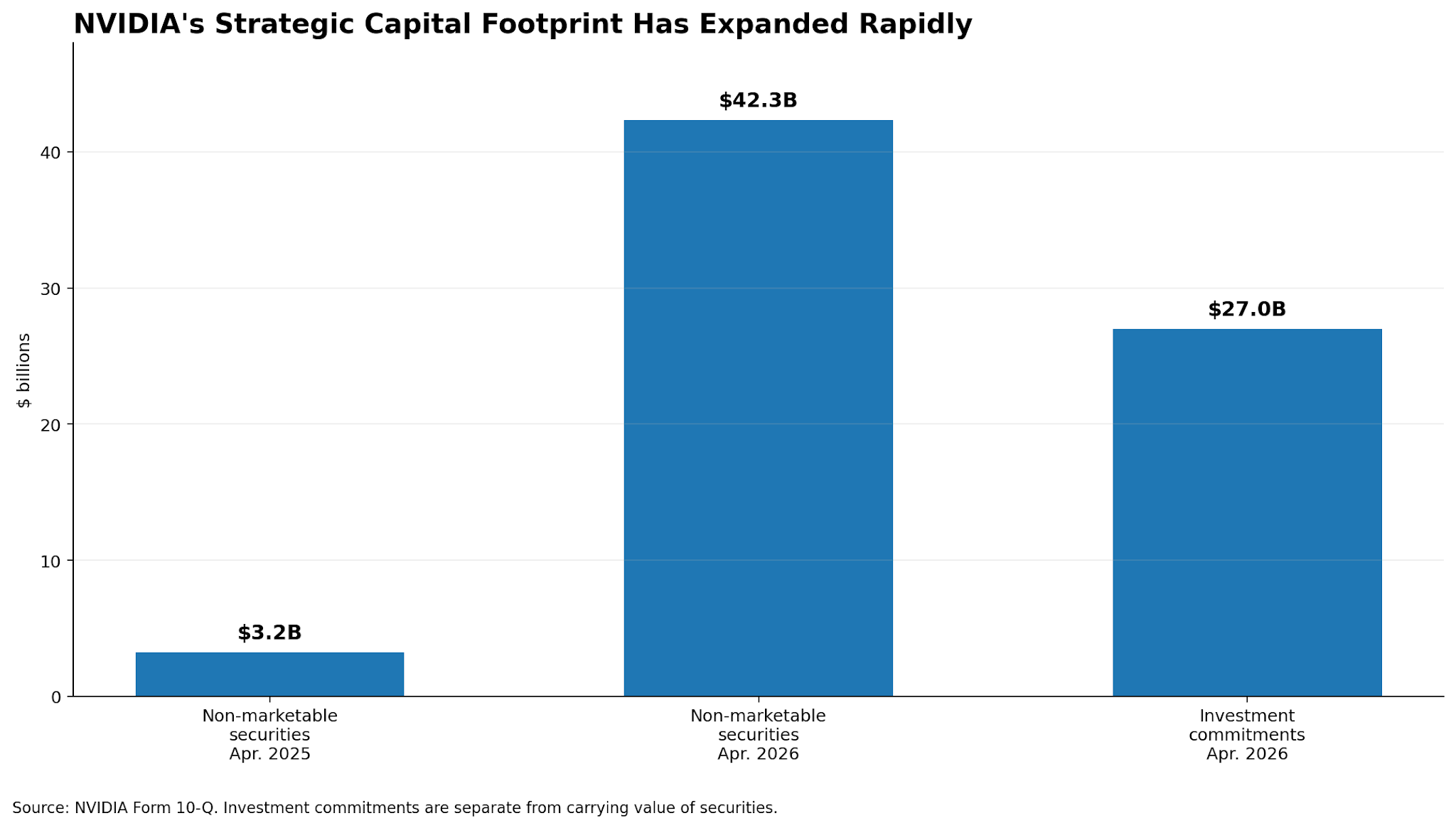
NVIDIA’s SEC filings make the shift measurable. Non-marketable equity securities rose from $3.24 billion at April 27, 2025 to $42.34 billion at April 26, 2026. NVIDIA also disclosed $27 billion of investment commitments as of April 26, 2026, subject to contingencies and expected to be made through the remainder of fiscal 2027.
The absolute amounts matter less than the rate of change. NVIDIA has accumulated enough financial capacity that strategic investing can influence ecosystem formation without changing the core economics of the chip business.
At April 26, 2026, NVIDIA also held $13.24 billion of cash and cash equivalents, $37.10 billion of marketable debt securities and $30.24 billion of marketable equity securities. Its first-quarter revenue was $81.6 billion. The company therefore has a balance sheet and cash-generation profile that allows it to support projects at a scale that most suppliers could not contemplate.
This is the strategic asymmetry: NVIDIA can use the profits generated by its dominant position to finance more infrastructure that reinforces that position.
4. The $500 Billion Compute-Financing Experiment
On August 10, NVIDIA announced memoranda of understanding with Apollo, BlackRock, Blackstone, Brookfield, Goldman Sachs and KKR to create independent compute-financing platforms. The stated target is to mobilize more than $500 billion of third-party capital over time.
This should not be interpreted as NVIDIA committing $500 billion. It is a target for capital mobilized through external financing platforms, and final agreements remain to be executed.
The more important feature is institutional design. NVIDIA is attempting to establish a recognizable financing category around compute. Goldman Sachs explicitly referred to creating a market for credit backed by NVIDIA compute. NVIDIA argues that its platform is suited to financing because the assets are broadly adopted, flexible across models and workloads, transferable across customers and operators, and continuously improved through CUDA software.
If financiers accept those premises, AI compute begins to resemble infrastructure equipment that can support debt rather than a rapidly depreciating technology asset that requires mostly equity capital.
That change can materially lower the cost of AI deployment. Infrastructure funds and private credit investors generally demand lower returns than venture equity. Moving part of the capital stack from equity to infrastructure-style credit can expand the number of projects that clear their financing hurdle.
5. PORTS-Pike: Where the Model Becomes Visible
The PORTS-Pike Technology Campus in Pike County, Ohio is the clearest current example of NVIDIA’s expanded role.
OpenAI has agreed to secure approximately 8 IT-GW at the campus. NVIDIA will be the exclusive AI compute infrastructure provider. NVIDIA announced a $1.5 billion investment in SB Energy and said it will provide credit support for land, power and shell associated with the initial 4.25 IT-GW, with an option related to the remaining 3.75 IT-GW.
The structure links four different economic actors:
- OpenAI provides long-duration compute demand.
- SB Energy develops the physical campus and associated infrastructure.
- NVIDIA provides compute and financial support.
- External lenders and capital markets can finance assets against the combination of demand, project infrastructure and NVIDIA credit support.
This is not traditional semiconductor selling. NVIDIA is helping create the project-finance conditions required for the customer to become large enough to buy future NVIDIA systems at extraordinary scale.
Reuters reported that NVIDIA’s potential guarantees could reach as much as $105 billion over the life of the project and relate to key lease and power obligations. Because the full contracts are not public, that figure should be treated as a reported potential exposure rather than a disclosed current liability.
6. CoreWeave: The Earlier Prototype
CoreWeave provides the most developed case of NVIDIA combining technology, customer economics and strategic capital.
In January 2026, NVIDIA invested $2 billion in CoreWeave common stock. The companies simultaneously announced an expanded relationship intended to accelerate more than 5 GW of AI factories by 2030 and to deploy multiple future NVIDIA platform generations.
The relationship is strategically powerful because CoreWeave converts NVIDIA hardware into rented compute. That broadens NVIDIA’s addressable market beyond customers capable of buying clusters outright. It also creates a specialist cloud that can absorb new GPU generations rapidly and make them available to AI labs and enterprises.
The risk is concentration and interdependence. CoreWeave depends heavily on NVIDIA hardware for competitive differentiation, while NVIDIA benefits when CoreWeave obtains the capital and customers required to keep purchasing new generations. The relationship can be economically rational for both parties without being fully independent.
This is why analysis should focus on the quality of end demand. If CoreWeave utilization and customer contracts are strong enough to support its infrastructure economics, NVIDIA’s capital support is an accelerator. If demand weakens, support can become a mechanism that delays price discovery.
7. Cloverleaf: Moving Upstream Into Power and Sites
On August 21, Reuters reported that NVIDIA made a minority investment in Cloverleaf Infrastructure to develop infrastructure that supports AI data-center projects across the United States.
This extends NVIDIA’s strategy farther upstream. A powered site is not a compute asset, but it is a prerequisite for one. In a market where time-to-power is increasingly scarce, investing in site development gives NVIDIA exposure to the earliest stage of the deployment funnel.
The strategic logic is consistent with PORTS-Pike: reduce the number of infrastructure bottlenecks that sit between theoretical GPU demand and an energized cluster.
This also creates a bridge to Solten & Co.’s broader time-to-power thesis. NVIDIA’s financing strategy and power strategy are converging. The company is not merely ensuring that customers can finance chips; it is increasingly participating in the chain that makes a site financeable, powered and capable of hosting those chips.
Exhibit 3 — NVIDIA Is Moving Upstream Across the AI Infrastructure Capital Stack
8. Compute as an Asset Class
The most consequential claim in NVIDIA’s August 10 announcement is not the $500 billion target. It is the assertion that NVIDIA compute can function as an investable asset class.
That claim requires several conditions:
- High utilization. Assets must generate enough usage revenue to service debt.
- Transferability. If one customer fails, capacity must be redeployable to another.
- Residual value. Older generations must retain enough economic utility to support conservative lending assumptions.
- Software durability. CUDA and the surrounding ecosystem must extend useful life beyond the hardware’s initial performance frontier.
- Deep offtaker markets. Lenders must believe there will be buyers for compute across AI labs, enterprises, sovereign projects and clouds.
- Operational reliability. Facilities must deliver uptime and performance consistent with contracted revenue.
NVIDIA can influence several of these variables directly. CUDA improves fungibility across workloads. DGX Cloud Lepton and cloud partnerships can broaden access to offtakers. Frequent hardware generations can increase demand for new assets, although they also create the depreciation risk that lenders must underwrite.
This tension is central. NVIDIA benefits from rapid product cycles, while credit investors prefer stable residual values. The financing market must reconcile those incentives.
9. The Financing Flywheel
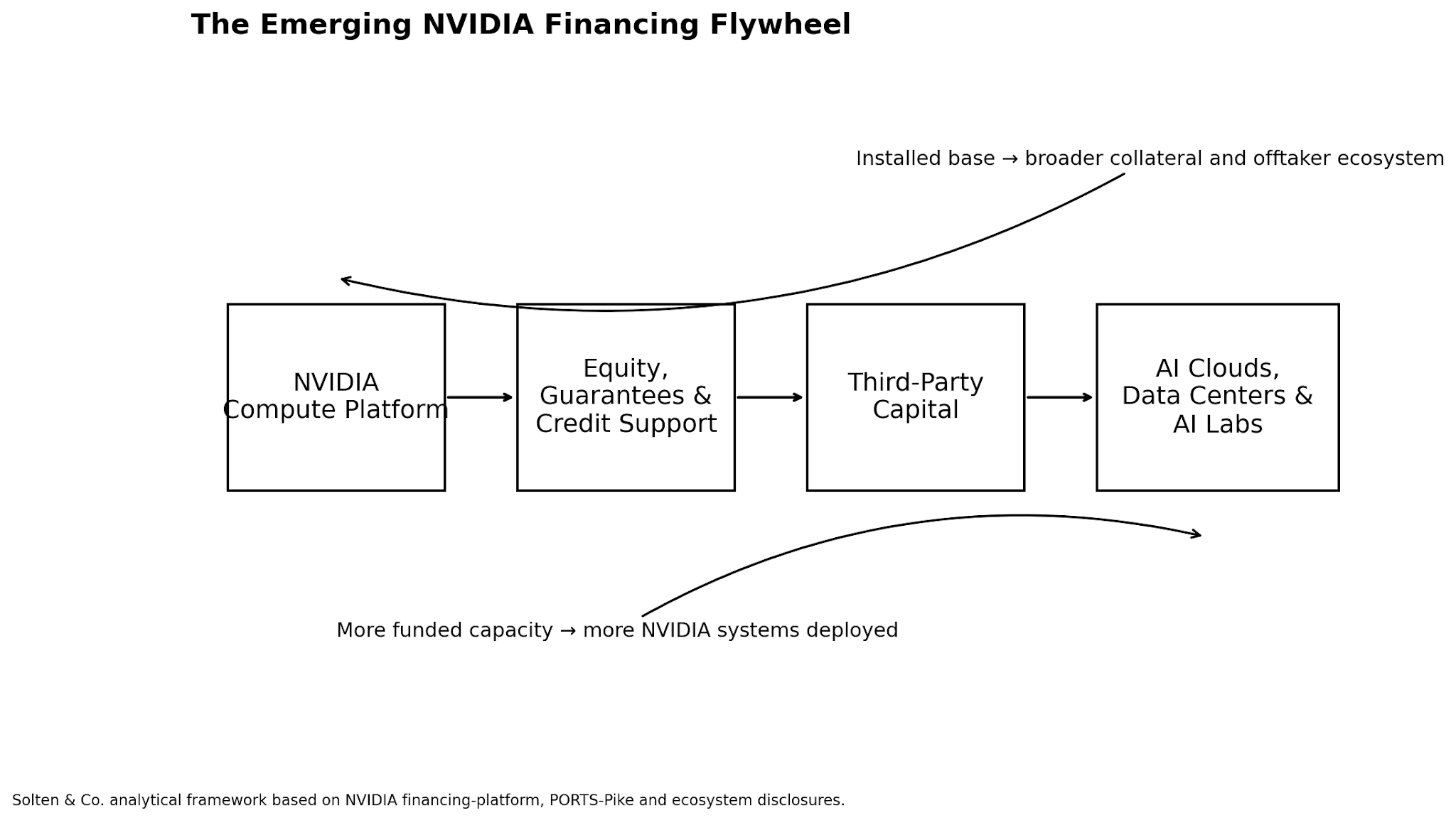
The emerging flywheel can be summarized as follows.
NVIDIA technology generates demand. Equity investments, guarantees, and credit support improve project bankability. Third-party capital finances more infrastructure. More infrastructure deploys more NVIDIA systems. A larger installed base expands the CUDA ecosystem and broadens the set of potential offtakers. That makes future NVIDIA-based projects easier to finance.
The flywheel matters because platform dominance can become embedded in financing standards. Once lenders build underwriting models around NVIDIA systems, project templates, resale assumptions, and utilization data can create institutional familiarity. Familiarity lowers transaction costs. Lower transaction costs can reinforce standardization.
This is analogous to other infrastructure markets where financing ecosystems accumulate around dominant equipment, operating models or contractual standards.
10. Why This Can Strengthen NVIDIA’s Moat
NVIDIA’s moat is usually described in technical terms: accelerator performance, CUDA, networking, system design and developer ecosystem. Financing adds another layer.
First, it can expand the customer base. Customers that cannot self-finance large clusters can access third-party capital.
Second, it can accelerate deployment. Credit support can move projects forward before customers accumulate enough cash or equity capital.
Third, it can increase switching costs. Financing documents, residual-value assumptions and infrastructure design may be built around NVIDIA architectures.
Fourth, it can defend against alternative accelerators. A technically credible competing chip may still face a financing disadvantage if lenders, developers and operators are more comfortable with NVIDIA-backed systems.
Fifth, it can make NVIDIA a gatekeeper in ecosystem formation. Strategic investment can influence which clouds, infrastructure developers and adjacent suppliers reach scale.
This is why the financing layer should be analyzed as part of competition, not merely corporate treasury activity.
11. Where Circularity Is Real — and Where It Is Not
The term “circular financing” has become shorthand for transactions in which an AI supplier finances a customer that then uses the proceeds to buy the supplier’s product. But the label can obscure important differences.
A direct equity investment in a customer can be circular in economic effect if the investment is required for the customer to purchase the investor’s product. A guarantee can create similar exposure if it is necessary for lenders to finance an otherwise uneconomic project.
But third-party financing is not automatically artificial demand. If an AI lab has a credible long-term contract for compute and infrastructure investors independently underwrite the project, supplier participation can simply reduce information and execution friction.
The key tests are therefore:
- Would the end customer demand exist without supplier financing?
- Is the project economically viable at market financing terms?
- Are lenders taking genuine independent risk?
- Does the supplier retain material downside through guarantees or residual-value support?
- Are utilization and contract assumptions externally verifiable?
- Does the transaction shift risk or merely hide it?
This framework is more useful than treating every ecosystem investment as evidence of a bubble.
12. The Credit Question
Equity investors can tolerate volatility and long periods before profitability. Credit investors require a different kind of evidence: contracted cash flow, asset recovery value, predictable utilization and enforceable security.
That means the next stage of AI infrastructure will generate new datasets. Lenders will need to understand GPU useful life, resale markets, utilization curves, power-price exposure, customer concentration, software obsolescence and the cost of moving hardware between operators.
In conventional digital infrastructure, lenders can underwrite fiber routes, towers and data-center leases using long operating histories. GPU clusters do not yet have that history at current scale.
That is the hidden importance of NVIDIA’s Wall Street partnerships. The company is not merely seeking more capital. It is helping create the underwriting methodology for a new category of credit.
13. Implications for AI Clouds and Infrastructure Developers
For AI clouds, NVIDIA-backed financing can lower the cost of growth. But it can also increase strategic dependence on one platform and encourage faster expansion than internally generated cash flow would support.
For data-center developers, access to NVIDIA-aligned demand and credit support can improve project financeability. The more valuable the NVIDIA ecosystem becomes to lenders, the more attractive it may be to design facilities around NVIDIA deployment standards.
For power developers, the relationship is moving even earlier in the lifecycle. PORTS-Pike and Cloverleaf show that NVIDIA has an incentive to secure land and power before a cluster exists.
The infrastructure stack is therefore becoming vertically coordinated without necessarily becoming vertically owned.
14. Implications for Capital Markets
If compute-backed credit becomes institutionalized, it can create a large new market spanning private credit, infrastructure debt, securitization, equipment finance and project finance.
The attraction is obvious. AI infrastructure can generate high contracted revenue, and hyperscalers or frontier labs can function as powerful offtakers. The risk is that multiple layers of the capital stack ultimately depend on the same underlying assumption: continued rapid growth in AI demand.
That creates correlation. Equity investors may believe they are financing a cloud company, credit investors a data center, infrastructure investors a power project and NVIDIA shareholders a semiconductor business — while all four returns may depend on the same end customer continuing to buy AI compute.
The financial system can therefore diversify legal entities without fully diversifying economic exposure.
15. Competitive Responses
NVIDIA’s strategy is unlikely to remain unique.
Google has incentives to use its balance sheet and cloud ecosystem to finance TPU deployments. Broadcom’s custom accelerator ecosystem can be paired with structured finance around hyperscaler or AI-lab capacity. Large cloud providers can support partners through leases, guarantees and offtake commitments.
Once financing becomes a competitive tool, accelerator competition can expand from performance-per-dollar into capital-per-deployed-compute: which platform can mobilize the cheapest, fastest and most scalable financing around its ecosystem.
This may favor companies with investment-grade balance sheets, large cash flows and established relationships with global capital providers.
16. Solten & Co. Thesis, Counter-Thesis and Falsification
Solten & Co. Thesis
NVIDIA is becoming the financing layer of the AI infrastructure ecosystem. Its strategic advantage increasingly combines technology, software, installed base, balance-sheet capacity and the ability to mobilize third-party capital. If compute develops into an accepted infrastructure asset class, NVIDIA can reinforce its platform moat by lowering the financing friction of NVIDIA-based deployment.
Counter-Thesis
The financing strategy may be a temporary response to an unusually tight market rather than a durable moat. GPU supply could normalize, customers could diversify toward custom accelerators, and rapid hardware generations could make residual-value underwriting difficult. If AI infrastructure returns compress, lenders may discover that “compute as an asset class” behaves more like cyclical technology equipment than long-duration infrastructure. NVIDIA could then be left with investment losses, guarantee exposure and customers that expanded too aggressively.
Falsification Criteria
- The announced $500 billion financing platforms fail to reach final agreements or mobilize material third-party capital.
- NVIDIA-backed projects require progressively larger guarantees to clear financing markets.
- Secondary-market values for older NVIDIA systems fall too quickly to support meaningful secured lending.
- Utilization or pricing for AI compute declines enough to make debt service materially less robust.
- Alternative accelerator ecosystems obtain comparable financing terms without NVIDIA’s installed-base advantage.
- Strategic investments generate repeated impairments or fail to translate into durable NVIDIA platform demand.
- Credit investors materially increase spreads or reduce advance rates on GPU-backed infrastructure.
17. What to Watch
Final terms of the $500 billion financing platforms. The memoranda of understanding are not yet final agreements. Watch how much direct risk NVIDIA retains.
NVIDIA’s August 26 earnings and filings. Additional disclosure on investment commitments, guarantees and strategic investments could clarify the scale of balance-sheet exposure.
PORTS-Pike financing. The eventual debt structure, guarantee mechanics and lender base will provide a benchmark for large AI project finance.
GPU-backed lending terms. Advance rates, depreciation assumptions, covenants and collateral substitution rules will reveal how credit markets value compute.
CoreWeave utilization and leverage. It remains one of the most important real-world tests of whether specialist AI-cloud economics can support large infrastructure commitments.
Cloverleaf project conversion. Watch whether powered-site origination translates into NVIDIA-exclusive or NVIDIA-preferred deployments.
Competitor financing structures. Google, Broadcom and hyperscalers are the most important reference points.
Residual values. The resale and redeployment economics of Hopper, Blackwell, Rubin and subsequent generations will determine whether compute behaves like durable collateral.
Sources & Evidence
Primary sources
NVIDIA — AI Compute Infrastructure Financing Platforms, August 10, 2026
NVIDIA — PORTS-Pike Technology Campus Credit Support, August 17, 2026
OpenAI — OpenAI joins PORTS-Pike project, August 17, 2026
https://openai.com/index/openai-joins-ports-pike-project/
NVIDIA — Form 10-Q for quarter ended April 26, 2026
https://www.sec.gov/Archives/edgar/data/1045810/000104581026000052/nvda-20260426.htm
NVIDIA — Fiscal 2027 First Quarter Results, May 20, 2026
CoreWeave — Form 8-K / NVIDIA $2 billion investment, January 2026
https://www.sec.gov/Archives/edgar/data/1769628/000176962826000044/crwv-20260123.htm
CoreWeave / NVIDIA — Expanded AI Factory Collaboration, January 26, 2026
https://www.sec.gov/Archives/edgar/data/1769628/000176962826000044/ex991pressrelease_final.htm
High-quality reporting
Reuters — NVIDIA invests in Cloverleaf Infrastructure, August 21, 2026
Reuters — NVIDIA to provide up to $105 billion guarantee for OpenAI Ohio data center, August 17, 2026
Financial Times — NVIDIA looks well placed to benefit from the next stage of the AI boom, August 20, 2026
https://www.ft.com/content/b388be2e-67bd-4056-abd2-234e17819a98
Methodological Note
This report does not aggregate NVIDIA equity investments, investment commitments, potential guarantees and third-party capital targets into a single exposure number because they represent different economic obligations.
The $500 billion figure is a target for third-party capital to be mobilized by financing platforms and is subject to final agreements. The reported potential $105 billion PORTS-Pike guarantee is based on Reuters reporting and is not treated as an existing funded liability. NVIDIA’s disclosed $1.5 billion SB Energy investment and credit support for initial land, power and shell capacity are treated separately.
The term financing layer is a Solten & Co. analytical concept. It describes NVIDIA’s emerging role in reducing capital-formation friction around AI infrastructure; it does not imply that NVIDIA is a regulated bank or that all NVIDIA ecosystem financing is controlled by NVIDIA.
About Solten & Co.
Solten & Co. is an independent research and analysis firm focused on the AI economy. We publish deep research and provide independent investment, company and market analysis for investors and decision-makers evaluating the technologies, businesses, markets and capital structures shaping the next phase of AI.
Need an independent perspective?
Solten & Co. provides independent research and analytical support for investors and decision-makers evaluating companies, markets and investment opportunities across the AI economy.