Solten & Co. Research Report
Updated: August 20, 2026
Research universe: AI Infrastructure / Software AI / Capital & Deals
Research Passport
- Publication type: Flagship Research Report
- Publication version: 1.0
- Published/updated: August 20, 2026
- Evidence cut-off: August 20, 2026
- Research universe: AI Infrastructure / Software AI / Capital & Deals
- Estimated reading time: ~25 minutes
- Original research exhibits: 3
- Primary and high-quality sources: 17+
Intended audience: investors, family offices, venture and growth funds, AI infrastructure operators, strategy leaders and other decision-makers evaluating frontier AI economics.
Key Findings
- Frontier AI is becoming an industrial system, not merely a software-model competition. Capital, power, data centers, silicon, cloud infrastructure, frontier models and distribution are now tightly coupled.
- The old “OpenAI is locked into Azure” narrative is no longer an adequate description of the market. Microsoft remains central, but OpenAI has deliberately built infrastructure and capital optionality across AWS, NVIDIA, Oracle, CoreWeave and other partners while renegotiating exclusivity.
- Anthropic’s multi-provider strategy has become materially larger than the roughly $50 billion compute picture often repeated in older analysis. By 2026, its disclosed relationships span AWS Trainium, Google/Broadcom TPUs, Microsoft Azure/NVIDIA capacity, SpaceX GPU infrastructure and additional infrastructure programs.
- Strategic AI transactions increasingly combine equity, compute purchase commitments, cloud distribution, IP/model access and commercial participation. Headline “investment” values can therefore be misleading unless the economic layers are separated.
- Long-term compute commitments deserve to be analyzed as quasi-fixed strategic obligations. The central risks are not only model performance but also demand, utilization, silicon obsolescence, falling compute prices, capital dependence, and counterparty concentration.
Table of Contents
- The Source Thesis — What the Sources Get Right
- OpenAI–Microsoft: The Original Strategic Flywheel
- Revenue Sharing: Real, Material — but Frequently Misdescribed
- The Biggest Update: OpenAI Is No Longer Simply “Locked into Azure”
- OpenAI’s AWS Pivot: From Azure Dependency to Infrastructure Portfolio
- Anthropic: Multi-Cloud as Strategy, Not Temporary Compromise
- Anthropic’s 2026 Scale-Up Makes the Original Numbers Obsolete
- Consumer vs. Enterprise: Useful Distinction, Weak Precision
- The Economics: The Real Constraint Is Not “Model Quality” but Cost of Intelligence
- The New Strategic Map: Reciprocal Dependence, Not Simple Cloud Control
- Capital Is Becoming Part of the Compute Contract
- Compute Commitments Are Emerging as a Form of Strategic Debt
- What the 2026 Market Says About Anthropic vs. OpenAI
- What to Watch Next — Investor Monitoring Framework
- Solten & Co. View
Scope & Methodology
Research question. This report examines how the strategic and economic relationships surrounding OpenAI and Anthropic have changed the competitive structure of frontier AI, with particular attention to capital, cloud distribution, compute commitments, silicon strategy, contractual optionality, and infrastructure dependence.
Scope. The report focuses on publicly disclosed or credibly reported relationships involving OpenAI, Anthropic, Microsoft, Amazon/AWS, Google, NVIDIA and selected infrastructure providers. It is not intended as a comprehensive valuation of either OpenAI or Anthropic, nor as an investment recommendation.
Evidence hierarchy. Priority is given to company disclosures, partner announcements, and other primary evidence. High-quality financial reporting is used where material commercial terms are not publicly disclosed. The report avoids treating media-reported terms as audited company facts.
Evidence classes used in this report:
DISCLOSED FACT — directly supported by a primary or authoritative source.
REPORTED TERM — reported by a credible secondary source but not independently disclosed by the relevant counterparty.
ESTIMATE — a quantitative or qualitative assessment based on incomplete public information.
SOLTEN & CO. INTERPRETATION — our synthesis, inference, or analytical conclusion.
Limitations. Large AI infrastructure agreements are unusually difficult to compare. A dollar investment, a multi-year compute purchase commitment, an “up to” gigawatt capacity announcement, and realized installed/utilized capacity are different economic objects. This report therefore avoids combining unlike commitments into a single headline total unless the units and assumptions are explicitly comparable.
What Changed
The sources captured an important structural shift toward infrastructure control, but several of its strongest claims have already aged materially.
OpenAI is no longer well described as a single-cloud, Azure-locked company. Its Microsoft relationship remains strategically important, yet exclusivity has been relaxed and major AWS, NVIDIA, and other infrastructure relationships now create meaningful supplier optionality.
Anthropic’s compute footprint has expanded far beyond the earlier multi-cloud figures frequently cited in 2025-era analysis. The company’s 2026 agreements make infrastructure diversification itself a core strategic capability.
The competitive framing has also changed. The relevant question is no longer simply whether hyperscalers “control” AI labs. The evidence points to reciprocal dependence: model labs need capital and compute, while hyperscalers and silicon vendors need frontier labs as anchor tenants, distribution engines, and validation customers for custom infrastructure.
Finally, the economic object called an “AI investment” is increasingly composite. Equity capital, compute commitments, distribution rights, model/IP access, and commercial revenue participation may sit inside the same strategic relationship. That makes transaction decomposition essential for serious investment analysis.
Executive Summary
The useful insight in the sources is that the frontier-model race can no longer be understood primarily as a benchmark contest. Compute, cloud distribution, capital structure, custom silicon, enterprise access, and contractual flexibility have become strategic variables in their own right.
But the market has moved materially since many of the arrangements described in the sources were formed. The most important update is that OpenAI is no longer accurately described as being structurally locked into Microsoft Azure in the old sense. Microsoft remains a major shareholder and a central strategic partner, but the relationship was progressively loosened in 2025 and 2026. OpenAI now has major compute and distribution relationships with AWS and NVIDIA, can serve products through other cloud providers under the amended Microsoft agreement, and has committed to large-scale multi-provider infrastructure. Microsoft’s OpenAI IP license is now non-exclusive, while OpenAI’s revenue share to Microsoft continues through 2030 subject to a cap.
Anthropic, meanwhile, has gone even further in constructing a deliberately diversified infrastructure strategy. AWS remains its primary cloud and training partner, but Anthropic also uses Google TPUs and NVIDIA GPUs, has Claude available across AWS Bedrock, Google Vertex AI and Microsoft Azure Foundry, and has accumulated multi-gigawatt capacity agreements across providers. In 2026, it also added SpaceX GPU capacity and expanded AWS and Google commitments dramatically.
This changes the central analytical conclusion. The emerging structure is not simply “hyperscalers own the AI labs.” It is better understood as a dense network of reciprocal dependencies: labs need capital, power, and compute; hyperscalers need frontier models to drive cloud demand, custom-silicon adoption, and enterprise AI distribution; chip vendors need anchor customers; investors need exposure to the model layer; and model companies increasingly seek infrastructure optionality to avoid strategic dependence on any single supplier.
The long-term advantage may therefore accrue not to one layer alone, but to actors that control scarce infrastructure while preserving bargaining power across the stack.
1. The Source Thesis — What the Source Gets Right
The source argues that the AI industry has entered a “middle game” in which model quality remains important but infrastructure control, compute access, and cloud distribution increasingly determine who can operate at frontier scale.
That framing is directionally correct.
Training and serving frontier models has become a capital-intensive industrial activity. The relevant inputs are no longer only algorithms and training data. They include data-center capacity, power, accelerators, networking, memory, inference infrastructure, custom silicon, cloud procurement and long-term financing. The frontier-model companies are therefore becoming unusually intertwined with hyperscalers, semiconductor vendors and infrastructure financiers.
OpenAI itself described the 2026 scaling problem in three words: “compute, distribution, and capital.” In February 2026, when announcing $110 billion of new investment, the company said leadership in the next phase would be defined by who could scale infrastructure fast enough to meet demand and convert that capacity into products used at global scale.
This is an important shift in how the sector should be analyzed. A useful company model can no longer stop at product quality, model benchmarks, or subscription growth. It must also ask:
- Who finances the company’s infrastructure?
- Which cloud providers distribute the models?
- What silicon does the company depend on?
- How much power and capacity has it contracted?
- Which agreements are exclusive?
- Which agreements create minimum-purchase or long-term compute obligations?
- Who receives revenue shares?
- Where can the company switch providers, and at what economic or technical cost?
- What does the infrastructure partner receive beyond direct cloud revenue — equity appreciation, custom-silicon validation, enterprise distribution or strategic leverage?
That is the stronger framework behind the source.
2. OpenAI–Microsoft: The Original Strategic Flywheel
Microsoft’s relationship with OpenAI began as a strategic shortcut into frontier AI. Microsoft invested $1 billion in OpenAI in 2019 and subsequently expanded the relationship through additional capital, cloud capacity, IP rights, and distribution arrangements.
The logic was powerful on both sides.
OpenAI received access to a hyperscaler capable of financing and deploying enormous compute clusters. Microsoft received privileged access to frontier-model IP, a differentiated Azure AI offering, and the ability to incorporate OpenAI technology across products such as Copilot and Microsoft 365.
For several years, this created a reinforcing system:
Microsoft capital → OpenAI compute demand → Azure revenue → OpenAI model improvement → Microsoft product differentiation → enterprise Azure demand.
The structure also made Microsoft simultaneously investor, infrastructure provider, distributor, and commercial beneficiary.
In October 2025, OpenAI completed a major recapitalization. Microsoft’s investment in OpenAI Group PBC was valued at approximately $135 billion, representing roughly 27% of the company on an as-converted diluted basis. OpenAI’s nonprofit parent — the OpenAI Foundation — held 26%, while employees and other investors held the remaining 47%.
This part of the source is substantially correct: Microsoft ended up with an economic stake in OpenAI worth about $135 billion, although the precise percentage is better stated as roughly 27%, not a loose 26–30% range.
3. Revenue Sharing: Real, Material — but Frequently Misdescribed
The Microsoft–OpenAI relationship has included revenue-sharing arrangements flowing in both directions.
Historically, reporting indicated that OpenAI agreed to share approximately 20% of revenue with Microsoft through 2030. In 2025, Reuters reported that OpenAI planned to reduce Microsoft’s share over time, but the companies subsequently confirmed that the revenue-sharing arrangement remained in place.
The structure changed again in April 2026.
Microsoft stated that it would no longer pay a revenue share to OpenAI. Revenue-share payments from OpenAI to Microsoft would continue through 2030 at the same percentage, but subject to an overall cap. Reuters subsequently reported, citing The Information, that the total future revenue-sharing obligation had been capped at approximately $38 billion.
This is materially different from the older picture in which reciprocal revenue sharing was treated as a relatively stable permanent mechanism.
The investment implication is important. Microsoft still has several distinct ways to benefit economically from OpenAI:
- Equity appreciation through its roughly 27% ownership position.
- Revenue-share payments from OpenAI through 2030, subject to the agreed cap.
- Azure consumption and broader infrastructure revenue.
- Product differentiation and enterprise distribution through Microsoft’s own AI products.
- Strategic spillovers into Microsoft’s cloud and developer ecosystem.
The source’s claim that Microsoft captured $865 million through revenue sharing in the first nine months of 2025 should be treated as an externally reported figure rather than a primary-source fact. We did not find a first-party Microsoft or OpenAI disclosure confirming that exact number. It may be useful context, but it should not be presented as audited public financial disclosure.
4. The Biggest Update: OpenAI Is No Longer Simply “Locked into Azure”
This is where the source narrative is now most outdated.
In early 2025, Microsoft still described the OpenAI API as exclusive to Azure and retained a right of first refusal on new compute capacity. The October 2025 agreement preserved Azure API exclusivity and Microsoft’s exclusive IP rights until AGI, while also allowing OpenAI greater freedom to build additional compute elsewhere.
By February 2026, OpenAI and Microsoft jointly clarified that Azure remained the exclusive cloud provider for stateless OpenAI APIs, even while OpenAI pursued additional compute relationships.
Then, in April 2026, the relationship changed more fundamentally.
Microsoft announced an amended agreement under which:
- Microsoft remains OpenAI’s primary cloud partner.
- OpenAI products generally ship first on Azure, unless Microsoft cannot or chooses not to support the required capabilities.
- OpenAI can serve its products to customers through any cloud provider.
- Microsoft’s license to OpenAI models and products through 2032 became non-exclusive.
- Microsoft stopped paying revenue share to OpenAI.
- OpenAI’s revenue-share payments to Microsoft continue through 2030, subject to a cap.
This is a major strategic shift.
The original Microsoft–OpenAI partnership was based on deep bilateral dependence. The revised structure increasingly resembles a major strategic partnership inside a broader multi-cloud and multi-capital network.
OpenAI’s subsequent AWS relationship makes this concrete.
5. OpenAI’s AWS Pivot: From Azure Dependency to Infrastructure Portfolio
In November 2025, OpenAI and AWS announced a $38 billion multi-year agreement under which OpenAI would use AWS infrastructure containing hundreds of thousands of NVIDIA GPUs.
In February 2026, that relationship expanded dramatically.
Amazon committed to invest $50 billion in OpenAI. OpenAI and AWS expanded their infrastructure agreement by another $100 billion over eight years. OpenAI committed to consume approximately 2 gigawatts of Trainium capacity, spanning Trainium3 and Trainium4, beginning to ramp in 2027.
AWS also became the exclusive third-party cloud distribution provider for OpenAI Frontier, while OpenAI and Amazon agreed to co-develop a stateful runtime environment in Amazon Bedrock and customized models for Amazon applications.
By June 2026, OpenAI frontier models and Codex were generally available on AWS.
OpenAI also announced 3 GW of dedicated NVIDIA inference capacity and 2 GW of training capacity on Vera Rubin systems, in addition to infrastructure already running across Microsoft, Oracle Cloud Infrastructure and CoreWeave.
The strategic implication is clear: OpenAI is deliberately creating infrastructure optionality.
This does not make Microsoft unimportant. Microsoft remains the primary cloud partner, major shareholder, and revenue-share recipient. But OpenAI now has multiple meaningful infrastructure and capital relationships, reducing the old single-provider concentration risk and increasing its bargaining flexibility.
6. Anthropic: Multi-Cloud as Strategy, Not Temporary Compromise
Anthropic’s infrastructure model has historically been more diversified than OpenAI’s.
AWS became Anthropic’s primary cloud provider for mission-critical workloads in 2023. In November 2024, Amazon added another $4 billion investment, bringing its total at that time to $8 billion, while AWS became Anthropic’s primary cloud and training partner.
Anthropic simultaneously deepened its Google relationship. In October 2025, it announced plans to use up to one million Google TPUs, with more than one gigawatt of capacity expected online in 2026. Anthropic explicitly described its compute strategy as diversified across Google TPUs, AWS Trainium, and NVIDIA GPUs.
In November 2025, Anthropic expanded into Microsoft Azure as well. Microsoft committed to invest up to $5 billion in Anthropic and NVIDIA up to $10 billion, while Anthropic committed to purchase $30 billion of Azure compute capacity. Claude became available in Microsoft Foundry, giving Anthropic distribution across AWS Bedrock, Google Vertex AI and Microsoft Azure.
This three-cloud distribution position was strategically unusual and important.
7. Anthropic’s 2026 Scale-Up Makes the Original Numbers Obsolete
The source cites Anthropic’s compute commitments at roughly $50 billion. That figure is no longer a useful description of current exposure.
In April 2026, Anthropic announced a new agreement with Google and Broadcom for multiple gigawatts of next-generation TPU capacity, expected to begin coming online in 2027. Anthropic said this was its most significant compute commitment to date.
Later that month, Anthropic expanded its AWS relationship to secure up to 5 GW of new capacity and committed more than $100 billion over ten years to AWS technologies. It said it was already using more than one million Trainium2 chips and that Amazon remained its primary training and cloud provider.
Amazon simultaneously invested another $5 billion, with the possibility of up to $20 billion more in future investment.
Anthropic also added more than 300 MW of NVIDIA GPU capacity through SpaceX’s Colossus infrastructure.
By mid-2026, Anthropic’s infrastructure strategy included:
- AWS Trainium — primary cloud/training relationship, up to 5 GW of new capacity.
- Google/Broadcom TPUs — multi-gigawatt next-generation capacity.
- Microsoft Azure/NVIDIA — $30 billion Azure capacity relationship.
- SpaceX — more than 300 MW of NVIDIA GPU capacity.
- Fluidstack — part of a broader $50 billion U.S. infrastructure program.
The strategic pattern is not merely “multi-cloud.” It is active procurement diversification across cloud vendors, silicon architectures, and physical infrastructure providers.
8. Consumer vs. Enterprise: Useful Distinction, Weak Precision
The source contrasts OpenAI as consumer-driven and Anthropic as enterprise-driven. This distinction is broadly useful, but the exact percentages cited in the source should be treated cautiously.
For OpenAI, Reuters reported in late 2025 that roughly 30% of revenue came from enterprise customers, implying that the majority still came from consumer-oriented products, particularly ChatGPT subscriptions. This supports the directional claim that OpenAI was more consumer-weighted than Anthropic.
For Anthropic, multiple sources confirm unusually strong enterprise adoption. In 2025, Reuters described Anthropic’s revenue acceleration as being driven by business demand, particularly coding. Anthropic reported more than 300,000 business customers in October 2025 and more than 500 customers spending over $1 million annualized by early 2026; that figure exceeded 1,000 by April 2026.
However, the claim that “85% of Anthropic revenue comes from B2B API calls” is not supported by the first-party sources reviewed here. Anthropic is clearly enterprise-heavy, but its revenue mix now includes subscriptions, Claude Code, direct enterprise contracts, API activity and hyperscaler distribution. A single percentage may be both unverifiable and quickly obsolete.
The deeper point is more important than the percentages:
OpenAI built a massive direct consumer distribution engine first, then pushed aggressively into enterprise.
Anthropic built stronger early positioning in enterprise and developer workflows, especially coding, while using broad hyperscaler distribution to reach customers inside existing cloud environments.
By 2026, both companies are converging toward enterprise distribution, making the old consumer-versus-enterprise binary less clean.
9. The Economics: The Real Constraint Is Not “Model Quality” but Cost of Intelligence
The source says OpenAI spends roughly $2 for every $1 of revenue. That framing is too simplistic for serious analysis.
OpenAI’s financial profile is undeniably capital-intensive, but reported figures must distinguish cash spending, compute costs, operating losses, and non-cash restructuring charges.
The Financial Times reported that OpenAI generated approximately $13 billion of revenue in 2025 while spending $34 billion. It reported a $39 billion net loss, but roughly $30 billion of that was a non-cash charge related to the prior investor structure. Excluding that charge and other non-cash items, operational losses were reported at around $8 billion.
This means the simple statement “OpenAI spends $2 for every $1 earned” may capture the scale of gross cash requirements at some point, but it is not a reliable representation of ongoing operating unit economics.
The more interesting economic question is how quickly inference costs decline relative to usage growth.
Frontier AI has a structural tension:
Better models → more demand → more inference → more infrastructure spending.
If price per unit of intelligence falls faster than compute efficiency improves, revenue growth may not translate proportionally into margin expansion.
This is why custom silicon and infrastructure bargaining power matter so much.
AWS wants Trainium adoption because custom silicon can reduce dependence on NVIDIA and capture more of the economics inside AWS.
Google wants TPU scale for the same reason.
Microsoft wants OpenAI-driven Azure demand and deeper software integration.
NVIDIA wants long-duration demand visibility from the frontier labs.
The model labs want enough supplier diversity to prevent any single infrastructure provider from capturing too much of their margin.
10. The New Strategic Map: Reciprocal Dependence, Not Simple Cloud Control
The source’s broader takeaway — that hyperscalers may be the true winners — is plausible but incomplete.
Hyperscalers clearly occupy a privileged position because they control data-center footprints, power procurement, networking, cloud distribution, enterprise relationships, and increasingly custom silicon.
But frontier labs also possess leverage.
A leading model company can move enormous volumes of compute procurement, validate a new chip architecture, attract cloud customers, strengthen an enterprise AI platform, and create equity gains for strategic investors.
This creates reciprocal dependence.
Consider AWS and Anthropic.
Anthropic needs AWS infrastructure. But AWS also uses Anthropic as the flagship proof point for Trainium. Project Rainier and more than one million Trainium2 chips give Amazon a reference customer at a scale few others can provide. Anthropic therefore helps AWS validate a strategic attempt to reduce dependence on NVIDIA.
Likewise, OpenAI’s 2 GW Trainium commitment is strategically important to AWS’s custom-silicon business.
The model companies are not merely buyers. They are anchor tenants for an emerging AI industrial infrastructure.
11. Capital Is Becoming Part of the Compute Contract
A striking feature of the current market is the increasing overlap between investor and supplier roles.
Microsoft is both a major OpenAI shareholder and infrastructure partner.
Amazon is both a major Anthropic shareholder and Anthropic’s primary cloud provider. It is now also a $50 billion OpenAI investor and major OpenAI compute supplier.
Google is an Anthropic investor and TPU/cloud partner.
NVIDIA invests in both model companies while also supplying the accelerators on which much of the industry depends.
This creates a new analytical problem for investors: headline “investment” announcements cannot be evaluated independently from procurement commitments, cloud contracts, revenue-sharing agreements and supplier incentives.
A strategic investment may effectively subsidize future infrastructure consumption. A compute commitment may in turn secure capital, distribution, or silicon priority.
Therefore, future Solten & Co. deal analysis should separate at least five economic layers in AI transactions:
- Equity investment.
- Compute purchase commitments.
- Cloud distribution rights.
- IP/model licensing rights.
- Revenue-share or commercial participation rights.
Without separating these layers, reported transaction values can be misleading.
12. Compute Commitments Are Emerging as a Form of Strategic Debt
Long-term compute commitments are not debt in the legal accounting sense, but economically they can behave like quasi-fixed obligations.
A lab that contracts tens or hundreds of billions of dollars of future capacity is making a bet on continued demand growth, model economics, and capital availability.
This creates several risks:
Demand risk — future AI usage may grow more slowly than contracted capacity.
Price risk — compute prices may fall faster than expected, making old commitments expensive relative to market alternatives.
Technology risk — a contracted silicon architecture may become less competitive.
Capital risk — the company may need continuous financing to fund capacity before operating cash flow catches up.
Utilization risk — infrastructure economics deteriorate sharply if expensive capacity is underused.
Counterparty risk — hyperscalers and infrastructure providers become increasingly exposed to the financial health of a small group of frontier labs.
This is one of the most important areas for future investment research because the market often celebrates giant compute commitments as evidence of confidence while under-analyzing their downside asymmetry.
13. What the 2026 Market Says About Anthropic vs. OpenAI
The competitive picture changed dramatically in 2026.
Anthropic reported run-rate revenue above $30 billion in April 2026, up from approximately $9 billion at the end of 2025. Reuters reported in August 2026 that Anthropic’s annualized run rate had exceeded $65 billion by the end of July.
This is far beyond the scale implied in the source.
OpenAI remains enormous, with unmatched consumer awareness and major enterprise ambitions, but recent reporting suggests stronger competitive pressure from Anthropic in coding and enterprise workloads.
The investment lesson is not that Anthropic has definitively “won.” It is that infrastructure strategy and distribution architecture can materially affect commercial outcomes.
Anthropic’s ability to be present inside all three major cloud ecosystems reduced customer procurement friction and gave it multiple infrastructure paths.
OpenAI, initially more concentrated around Microsoft, has spent 2025–2026 building similar optionality through AWS, NVIDIA, Oracle, CoreWeave and Stargate.
The two firms are therefore converging toward a common strategic requirement: no frontier lab wants to depend on a single source of capital, compute, or distribution.
14. What to Watch Next — Investor Monitoring Framework
For investors analyzing frontier AI, cloud infrastructure or adjacent companies, the following metrics may now be more informative than benchmark leadership alone.
Infrastructure concentration
What percentage of training and inference depends on each provider?
Committed capacity
How much future compute, power, and data-center capacity is contractually committed?
Compute economics
What is the effective cost per training run, per inference token or per unit of delivered intelligence?
Silicon mix
How exposed is the company to NVIDIA versus Trainium, TPU or other accelerators?
Distribution breadth
Can the company sell through AWS, Azure, Google Cloud, and directly?
Revenue concentration
How dependent is growth on consumers, coding tools, API use or a small number of enterprise customers?
Capital dependency
How much external funding is required before free cash flow becomes plausible?
Strategic investor overlap
Are suppliers also shareholders? Do those relationships distort apparent pricing or economics?
Contract flexibility
Can the company shift workloads across providers when technology or economics change?
Infrastructure utilization
Are contracted gigawatts translating into monetized demand?
15. Solten & Co. View
The frontier AI market is evolving from a software race into an industrial system.
That system has at least six tightly coupled layers:
Capital → Power/Data Centers → Silicon → Cloud Infrastructure → Frontier Models → Applications/Distribution.
The key strategic question is no longer only who has the best model.
It is who can secure sufficient capital and infrastructure without surrendering too much economics or strategic flexibility to the companies supplying that infrastructure.
OpenAI’s 2025–2026 evolution is a case study in reducing dependency. Microsoft remains central, but OpenAI has steadily expanded into AWS, NVIDIA, and other infrastructure partners while renegotiating exclusivity.
Anthropic is a case study in diversified infrastructure from an earlier stage. AWS remains primary, but Anthropic has systematically maintained access to multiple clouds and silicon architectures.
The hyperscalers are likely to capture enormous value because the frontier-model boom drives cloud demand, custom-silicon adoption and enterprise AI distribution. But the idea that they will automatically own the economics is too simple.
The more likely equilibrium is a small number of frontier labs and infrastructure giants locked in reciprocal dependence, each attempting to diversify enough to preserve bargaining power.
For investors, the most underappreciated layer may be the contracts connecting them.
Those contracts — compute commitments, distribution rights, strategic investments, revenue shares and silicon partnerships — increasingly determine which companies have flexibility, which carry hidden obligations, and where economic value ultimately accrues.
Fact-Check: Selected Claims from the Source
Claim: Microsoft owns approximately 26–30% of OpenAI, worth about $135B.
Status: Substantially verified. Microsoft disclosed roughly 27%, valued at approximately $135B after the October 2025 recapitalization.
Claim: Microsoft receives roughly 20% of OpenAI revenue through 2030.
Status: Historically supported by reporting; the 2026 amended agreement kept the same percentage through 2030 but added a total cap. Reuters later reported the cap at approximately $38B.
Claim: OpenAI receives roughly 20% of Azure OpenAI/Bing AI revenue.
Status: Reciprocal revenue sharing existed historically, but this is now outdated. Microsoft said in April 2026 that it would no longer pay a revenue share to OpenAI.
Claim: OpenAI committed to purchase $250B of Azure services.
Status: Verified as an October 2025 incremental Azure commitment. However, the broader relationship has since changed materially, and OpenAI has added very large AWS and NVIDIA commitments.
Claim: Microsoft has exclusive API distribution rights until AGI.
Status: Outdated. This described the earlier structure. The April 2026 amendment materially relaxed exclusivity and made Microsoft’s IP license non-exclusive, while OpenAI gained the ability to serve products through other clouds.
Claim: Anthropic has approximately $50B in compute commitments across providers.
Status: Outdated. Anthropic’s 2026 commitments expanded far beyond this number, including more than $100B committed to AWS alone over ten years, multi-gigawatt Google capacity, $30B of Azure capacity and additional GPU infrastructure.
Claim: Anthropic uses up to 1M Google TPUs and around 1 GW of Google capacity.
Status: Verified as the October 2025 announced plan. The Google/Broadcom relationship expanded again in April 2026 into multiple gigawatts of next-generation TPU capacity.
Claim: Amazon invested $8B in Anthropic and AWS is its primary cloud provider.
Status: Verified historically. Amazon’s total investment has since increased, and AWS remains Anthropic’s primary cloud and training provider.
Claim: Anthropic is available through AWS Bedrock, Google Vertex AI and Azure Foundry.
Status: Verified. Anthropic describes Claude as the only frontier AI model available across all three major cloud platforms.
Claim: OpenAI is ~73% consumer revenue and Anthropic ~85% B2B API revenue.
Status: Directionally plausible but not sufficiently supported at those exact percentages by primary evidence reviewed. Reuters reported roughly 30% enterprise revenue for OpenAI in late 2025 and consistently described Anthropic growth as enterprise-led. Exact percentages should not be used without a dated underlying source.
Claim: OpenAI spends roughly $2 for every $1 of revenue.
Status: Oversimplified. OpenAI is highly cash-intensive, but reported losses include major non-cash items and changing compute economics. Use specific period financial data instead of a permanent ratio.
Primary and High-Quality Sources
Microsoft — The next chapter of the Microsoft–OpenAI partnership, Oct. 28, 2025
https://blogs.microsoft.com/blog/2025/10/28/the-next-chapter-of-the-microsoft-openai-partnership/
OpenAI — Our Structure
https://openai.com/our-structure/
OpenAI/Microsoft — Joint Statement, Feb. 27, 2026
https://openai.com/index/continuing-microsoft-partnership/
Microsoft — The next phase of the Microsoft–OpenAI partnership, Apr. 27, 2026
https://blogs.microsoft.com/blog/2026/04/27/the-next-phase-of-the-microsoft-openai-partnership/
Reuters — OpenAI/Microsoft revenue-share cap report, May 12, 2026
OpenAI — AWS and OpenAI multi-year strategic partnership, Nov. 3, 2025
https://openai.com/index/aws-and-openai-partnership/
OpenAI — OpenAI and Amazon strategic partnership, Feb. 27, 2026
https://openai.com/index/amazon-partnership/
OpenAI — Scaling AI for everyone, Feb. 27, 2026
https://openai.com/index/scaling-ai-for-everyone/
OpenAI — Frontier models and Codex available on AWS, Jun. 1, 2026
https://openai.com/index/openai-frontier-models-and-codex-are-now-available-on-aws/
Anthropic — Powering the next generation of AI development with AWS, Nov. 22, 2024
https://www.anthropic.com/news/anthropic-amazon-trainium
Anthropic — Expanding our use of Google Cloud TPUs and Services, Oct. 23, 2025
https://www.anthropic.com/news/expanding-our-use-of-google-cloud-tpus-and-services
Anthropic — Microsoft, NVIDIA and Anthropic strategic partnerships, Nov. 2025
https://www.anthropic.com/news/microsoft-nvidia-anthropic-announce-strategic-partnerships
Anthropic — Google/Broadcom next-generation compute expansion, Apr. 6, 2026
https://www.anthropic.com/news/google-broadcom-partnership-compute
Anthropic — Amazon compute expansion, Apr. 20, 2026
https://www.anthropic.com/news/anthropic-amazon-compute
Anthropic — Higher limits and SpaceX compute partnership, 2026
https://www.anthropic.com/news/higher-limits-spacex
Reuters — Anthropic annualized revenue reached $3B on business demand, May 30, 2025
Reuters — Anthropic revenue run rate tops $65B, Aug. 17, 2026
https://www.reuters.com/technology/anthropic-revenue-run-rate-tops-65-billion-source-says-2026-08-17/
Financial Times — OpenAI spending hit $34B in 2025
https://www.ft.com/content/e15b0d7e-ff6b-4f16-ba7a-4068feddb828
Evidence & Publication Note
Publication-ready research report. The analysis separates disclosed facts, externally reported terms, and Solten & Co. interpretation, and includes original research exhibits covering selected compute capacity, partnership structure, and the evolution toward multi-provider infrastructure portfolios.
Research Exhibits
Exhibit 1 — Selected Announced Frontier-Lab Compute Capacity
The figures below capture disclosed capacity announcements, not directly comparable installed capacity. Timing, silicon, workload type, and “up to” language differ materially across agreements.
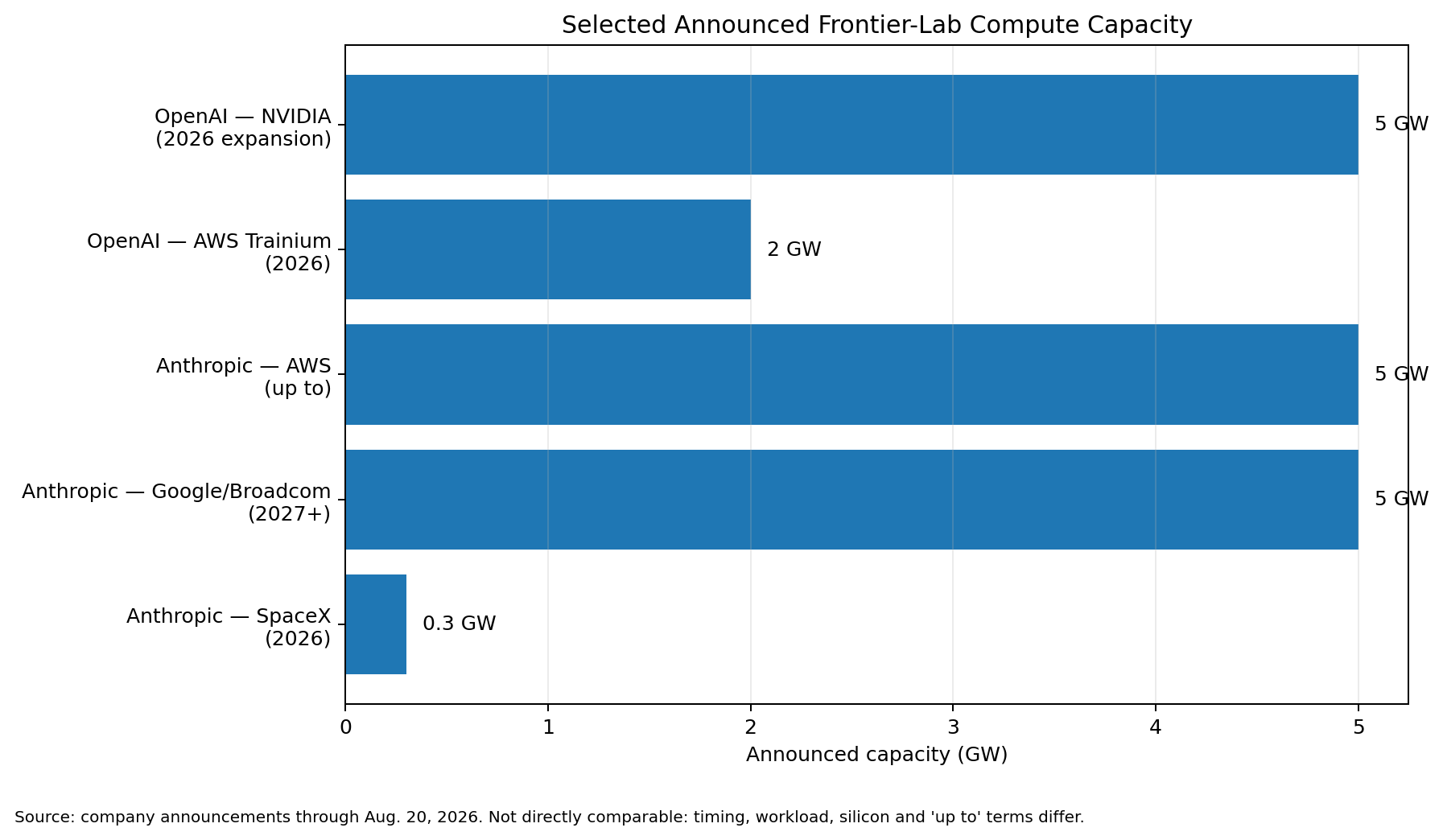
Exhibit 2 — AI Strategic Partnerships Are Multi-Layer Transactions
The same counterparty can simultaneously be an investor, compute supplier, distributor, model-access partner and commercial beneficiary. This is why headline investment values alone are poor representations of the underlying economics.
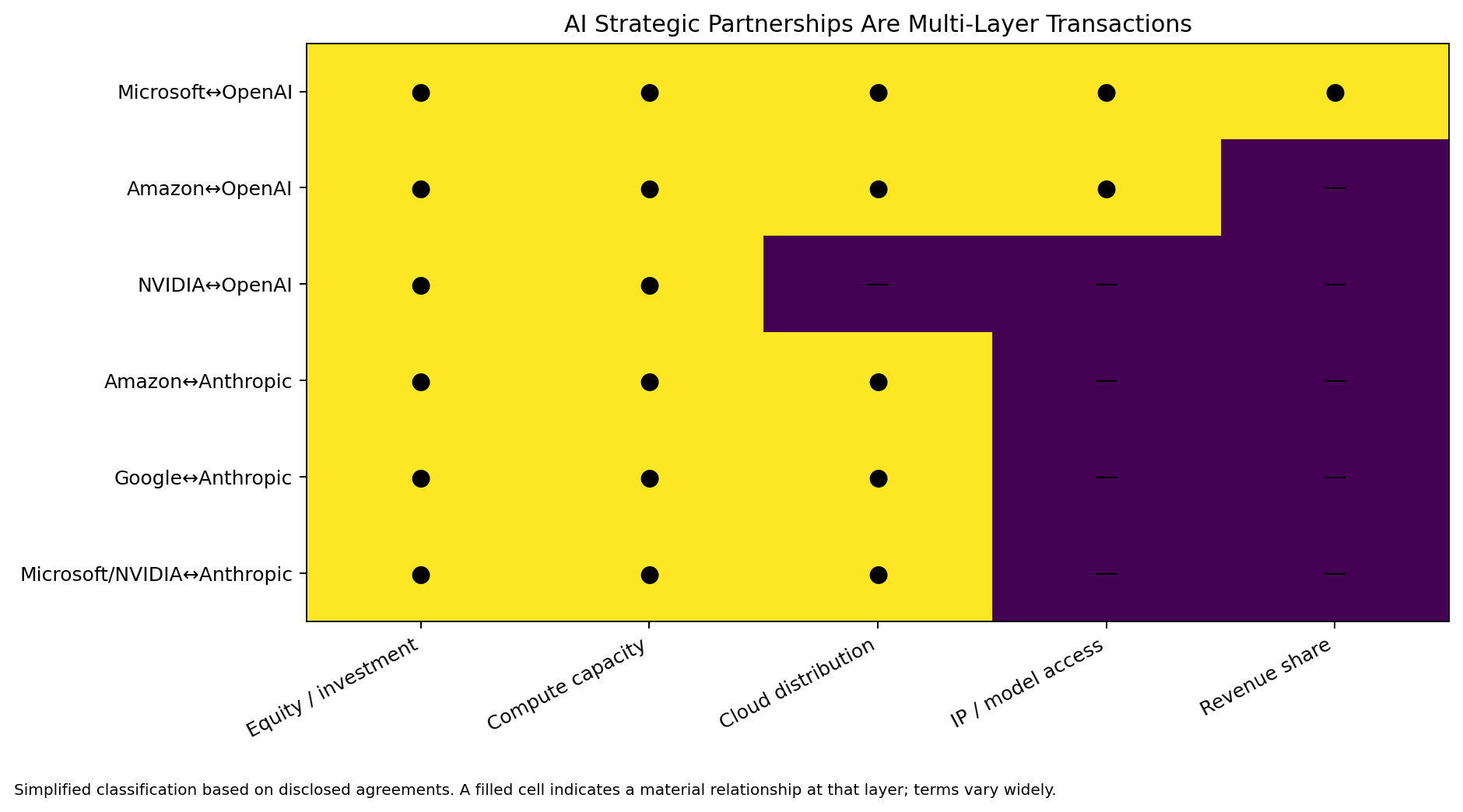
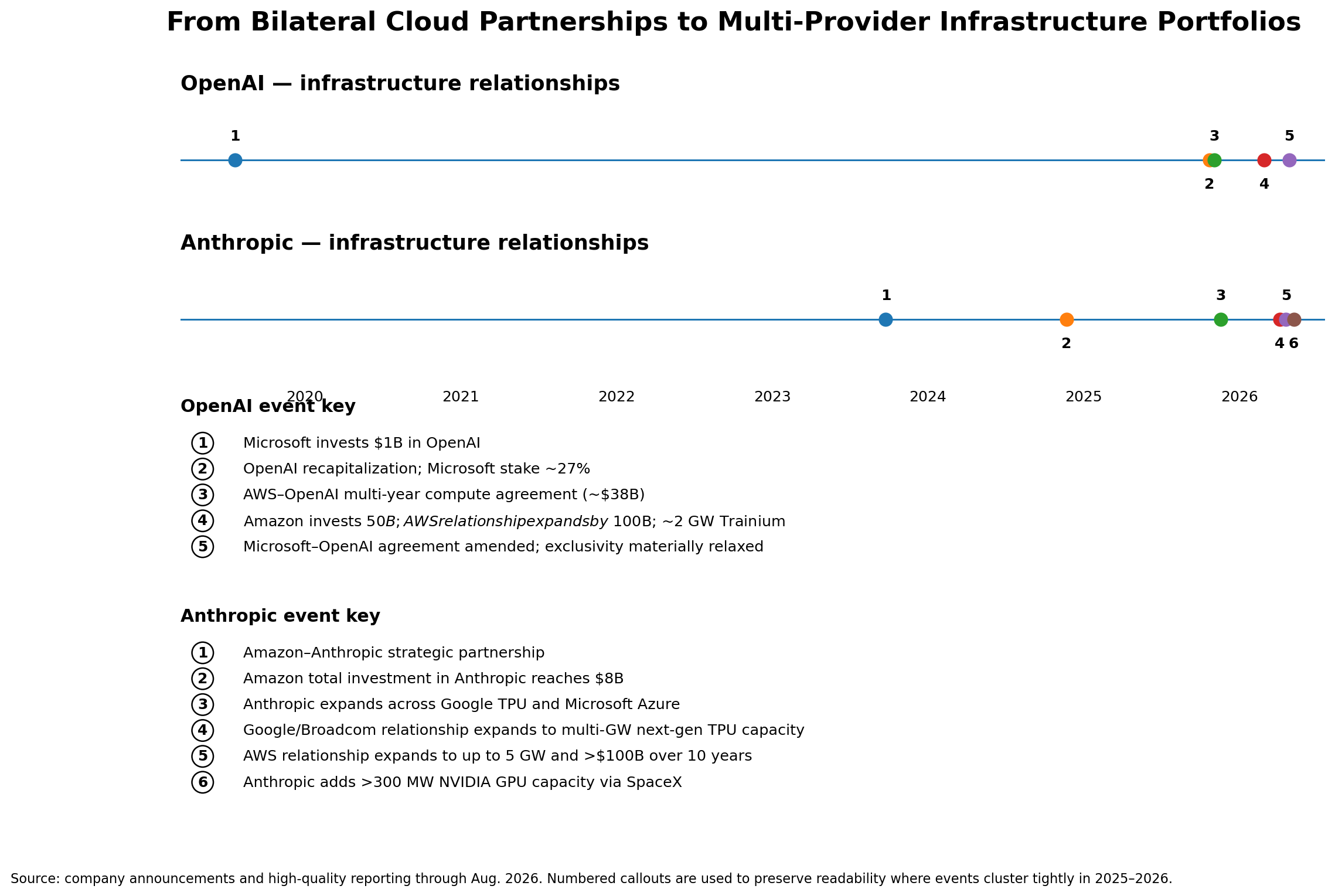
Exhibit 3 — From Bilateral Cloud Partnerships to Multi-Provider Infrastructure Portfolios
The chronology shows the strategic shift from relatively concentrated bilateral relationships toward overlapping networks of capital, compute, and distribution.
Methodological Note
These exhibits are based on disclosed company announcements and high-quality reporting available through August 20, 2026. They intentionally avoid converting unlike commitments into a single headline value. Gigawatts describe capacity; dollars describe investments or contractual purchase obligations; neither is equivalent to realized utilization or economic value. Where terms are described as “up to,” the chart retains that qualification in the underlying analysis.
About Solten & Co.
Solten & Co. is an independent research and analysis firm focused on the AI economy, with deeper research emphasis on AI infrastructure, Physical AI, robotics, and autonomous systems. We study the technologies, companies, markets, transactions, and capital structures shaping the next phase of AI.
Need an independent perspective?
Solten & Co. provides independent research and analytical support for investors and decision-makers evaluating companies, markets, and investment opportunities across the AI economy.
Discuss a research question · Discuss an investment opportunity · Request independent analysis.